 Jean Shia
 Ishita Jain

The Autodesk Foundation launched its Impact Measurement and Management (IMM) function in 2019 to put impact accountability at the center of our philanthropy. Fundamentally this means articulating our investment intent and defining clear, intended impact outcomes which can be measured and evaluated over time. This happens at the portfolio level starting with our Theories of Change (Energy & Materials, Health & Resilience, Work & Prosperity) and then in partnership with individual grantees and investees when we aggregate impact metrics on an annual basis, the latest of which showcases our portfolio outcomes for 2025.
As our portfolio investment strategy has matured, we have invested across a wider span of organizational lifecycles, technology domains, and business models. Our impact measurement practice also needed to evolve to comprehensively assess the impact of our changing portfolio and help inform our strategy going forward, helping us to answer questions like: are we enabling the intended outcomes we articulated in our theory of change, how do we right size expectations for IMM across a diverse portfolio, and how do we improve our understanding and evidence of impact at a systems level?
To address those questions, we developed a set of Impact Pathways, a framework that complements aggregated metrics by recognizing the different ways organizations contribute to long-term impact across two fundamental parameters: size of impact (early innovation vs scale stage) and vector of impact (direct enterprise vs ecosystem).
This blog is the first of our Insights Series, which elevates our recent learnings across philanthropy and impact investing. We invite you to read more about how our impact pathways framework shapes how we deliver impact with accountability.
– Jean Shia, Managing Director, Autodesk Foundation
How Impact Pathways are organized
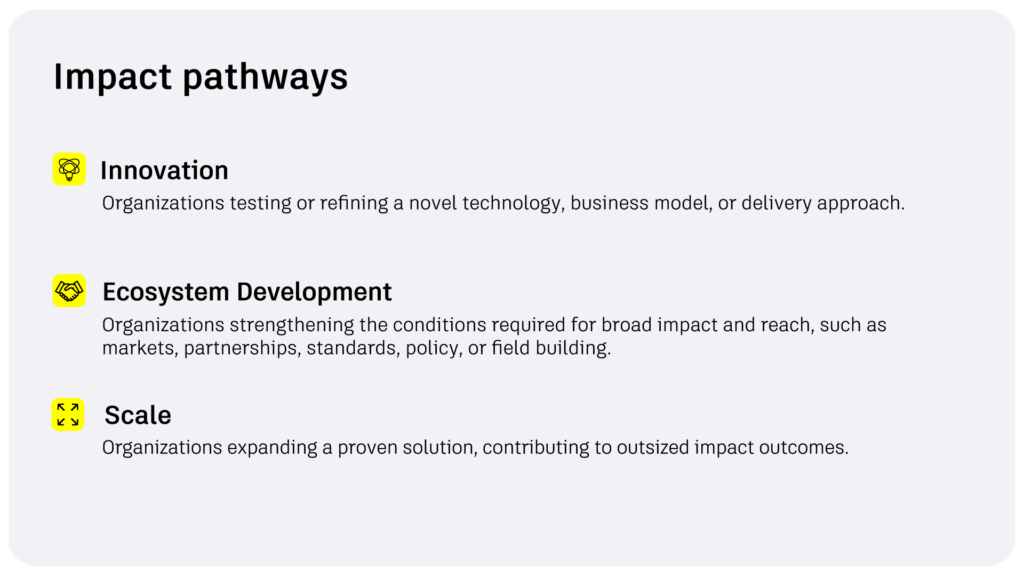
Impact Pathways organize our portfolio across three distinct categories: Scale, Innovation, and Ecosystem Development.
Scale: Organizations expanding a proven solution contributing to outsized impact outcomes (ex. number of individuals reached with resilient solutions or reduced emissions at meaningful volume). For example, as of 2025, Fika, an organization in our Health & Resilience portfolio, reached ~5.2 million individuals through its public access infrastructure.
Innovation: Organizations testing or refining a novel technology, business model, or delivery approach with the potential to unlock future impact. For example, Avalanche Energy, an organization in our Energy & Materials portfolio, is developing and testing novel fusion technology. The company is still refining an early-stage technical solution though has not yet delivered realized emissions reductions.
Ecosystem Building: Organizations strengthening the conditions required for broader impact, such as markets, partnerships, standards, policy, or field building. For example, SEAF, an organization in our Work & Prosperity portfolio, strengthens the small-business ecosystem by connecting entrepreneurs to capital, networks, and capacity-building support needed for sustainable growth.
Setting expectations
This helps us define success based on an organization’s current stage of development and shape how we evaluate impact. We would not, for example, expect an early-stage Innovation organization to immediately report the same metrics or numbers as an established Scale organization. Instead, we may focus on the strength of its pilots, efficiency gains, lessons from experimentation, and or potential path to scale. For example, M2X Energy has expanded its work to focus on converting methane from landfills to low carbon fuels and have gained significant commercial traction and are well poised to deliver GHG emission reductions in the near future.
For Scale organizations, we focus on the factors enabling greater reach and the role our funding has played in that growth. For Ecosystem Development organizations, we explore partnerships, market development, and changes in the broader system.
Reflecting multiple dimensions of impact
The framework also allows us to capture multiple dimensions of impact beyond breadth alone, including depth, durability, and ecosystem impacts.
In practice, this means we are not trying to gauge success of every organization toward the highest near-term metric outputs; instead, we recognize that different organizations create value in unique ways, and that a strong portfolio needs a deliberate mix of Impact Pathways to achieve meaningful, long-term impact.
Informing portfolio construction and funding decisions
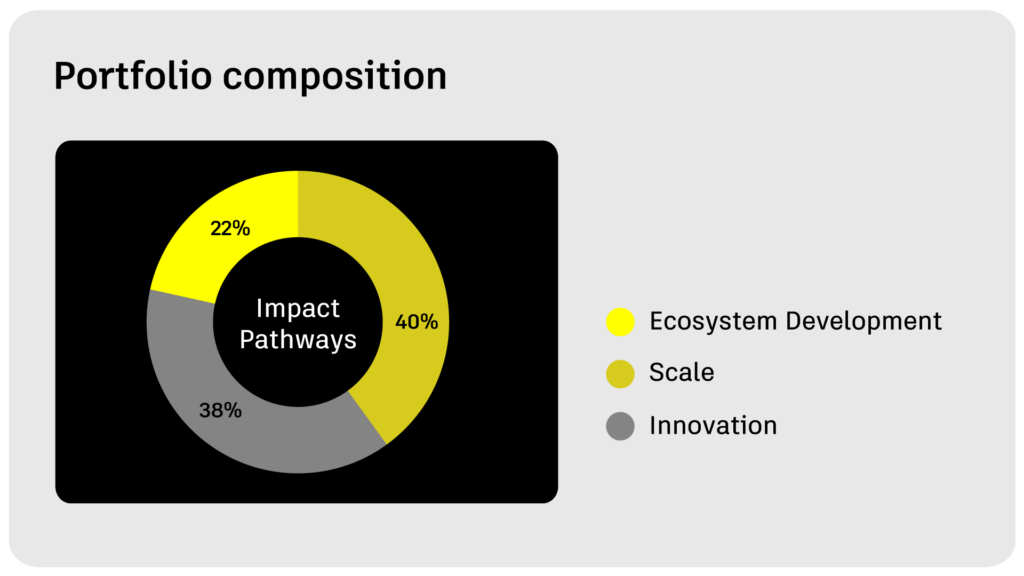
At the portfolio level, the framework helps us assess whether we have the right portfolio composition to achieve our strategic goals. Through this lens, we can more clearly identify gaps and assess target portfolio composition and redirect future funding as necessary.
Operationalizing Impact Pathways
We are embedding Impact Pathways into both diligence and reporting. During due diligence for a new portfolio organization, we assign them to an Impact Pathway. This clarifies the primary role an organization may play in the portfolio from the outset, whether through scale, innovation, or ecosystem development. At the end of the portfolio organization’s reporting cycle, revisiting these pathways allows us to assess whether that role has evolved, what we have learned, and how the organization’s impact contribution should be understood beyond aggregated outputs alone.
This categorization is not static; organizations may move between pathways until they outgrow our support and graduate out of the portfolio. One portfolio organization, for example, initially entered the portfolio through the Innovation pathway while it tested and refined its model. As the organization built evidence, demonstrated demand, and expanded delivery, its primary role shifted toward Scale. Reclassifying the organization allowed us to adjust our expectations from focusing on experimentation and model validation to examining reach, quality, and the factors enabling sustained growth.
Long-term accountability
As we expect our portfolio to evolve and grow, so too, should our own practice. The addition of Impact Pathways allows us to better understand our impact over the long-term and apply those insights to inform stronger decision-making over time, ultimately keeping impact accountability at the center of our work.
We’d love to hear how others are evolving their IMM practices, whether as funders, implementers, or ecosystem partners. Reach out to us on LinkedIn.
This blog is part of our Insights Series through which our team shares recent learnings from corporate philanthropy across Impact Measurement and Management, in-kind support to our portfolio, employee impact programming, and more. Please follow us on LinkedIn to see the latest in our Insights Series.