 Jesper Staahl
Curious to try Forma Building Design? Register for the closed beta here.
Decisions made during schematic design last a building’s lifetime. Long before it’s time for construction documents, material selections, detailed engineering — the fundamental choices made here define massing, spatial organization, building orientation, unit layout, and core placement. They’re especially critical in multifamily projects because they don’t just affect one unit but scale across 50, 100, 200 or more units. To get these decisions right requires rigorous exploration during schematic design to ask questions, test ideas, check performance, and fine tune numbers. For this phase to be effective requires time, flexible tools, and an efficient workflow that enhances iteration rather than penalises it.
Schematic design: a balancing act
As architects, we need to consider multiple factors in parallel during schematic design to shape design options to meet the client’s brief, testing:
- Massing: Testing building form, height, and footprint against zoning envelopes
- Spatial organization: Establishing circulation, core locations, unit types, and adjacencies
- Site response: Evaluating orientation, daylight access, solar exposure, and context
- Performance framing: Setting the baseline for energy efficiency, carbon targets, and environmental standards
- Yield analysis: Confirming unit counts, efficiency ratios, and financial viability
Making tradeoffs is a challenge with so many interconnected factors: how do you weigh up the pros and cons of each design option?
When decisions – and mistakes – scale
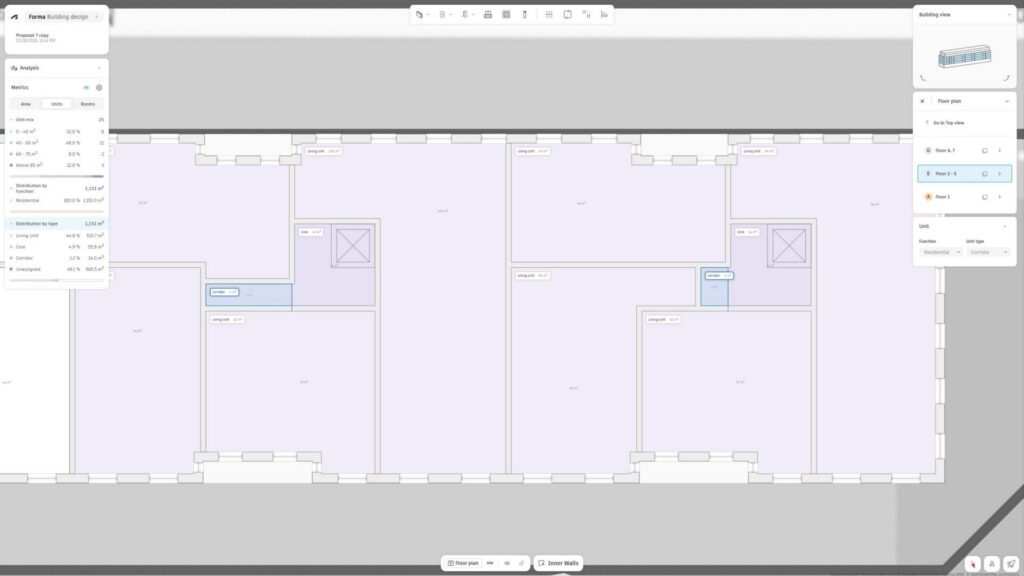
For example, every square foot of inefficiency at the schematic design stage compounds across the project’s entire unit count, amplified by the repeated geometry of multifamily residential layouts. A core layout that adds four feet of dead corridor on each floor adds hundreds of square feet of non-leasable area by the time it reaches the 20th floor. A facade configuration that reduces solar gain by 15% improves the energy efficiency of every unit with that orientation. A unit mix established in schematic design shapes leasing strategy, financing assumptions, and long-term asset performance.
The real cost of limited iteration
The constraint in most schematic design workflows isn’t skill or intent. It’s time. Each design option needs to be modelled from scratch, its own daylight study, its own yield calculation. A team that sets out to explore ten schemes may realistically evaluate three before looming deadlines demand a direction. Committing too early might risk narrowing design exploration prematurely.
This potentially creates a subtler problem: sunk cost fallacy. When effort has been invested in a design scheme, it becomes harder to set it aside — even when performance analysis suggests a better option.
Consider a common scenario: an urban infill project targeting 180 units within a tight zoning envelope. A double-loaded corridor scheme and a courtyard alternative both need to be tested. Each requires separate modeling. Daylight studies take time to commission and return. Unit yield calculations need updating after every design change. Weeks pass before the two options can be meaningfully compared — by which point the team may already have a picked a preference to keep pace with the project schedule.
What better design exploration changes
The evolution happening in schematic design architecture focuses precisely on this point: where massing is still fluid and options are still open. It isn’t about replacing BIM or restructuring how architects work. Revit remains the right environment for detailed modelling. The question is what happens before geometry is locked in.
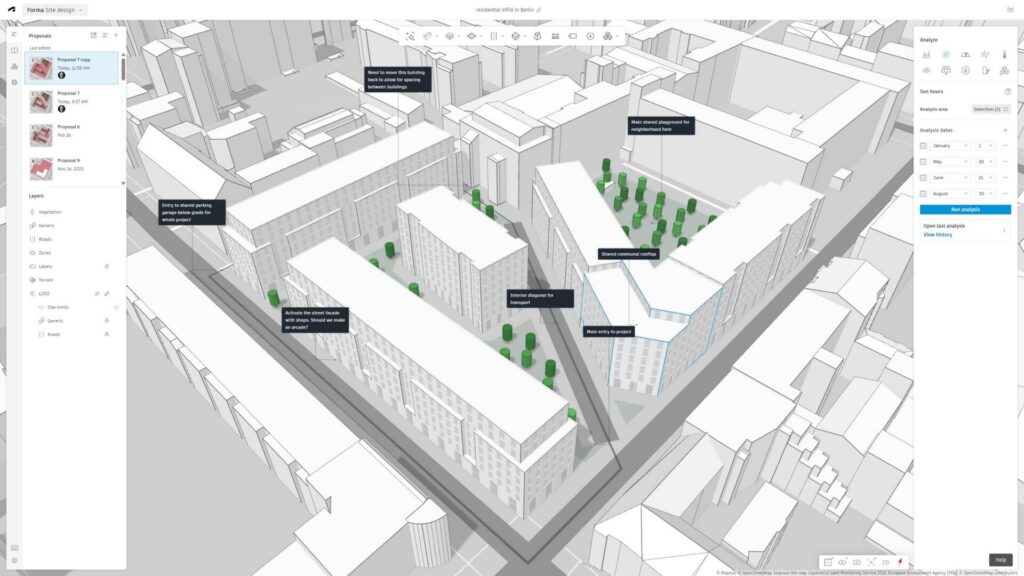
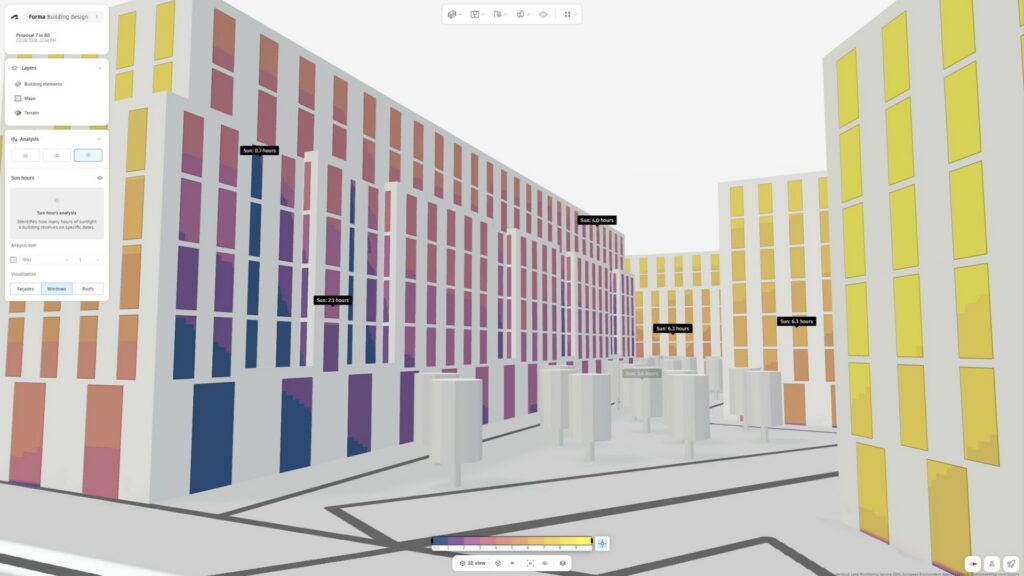
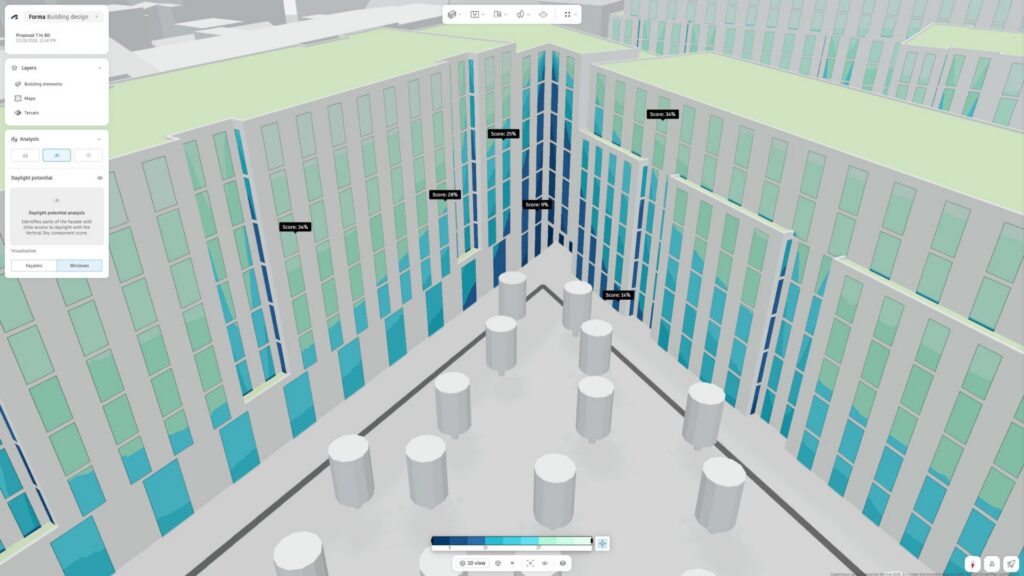
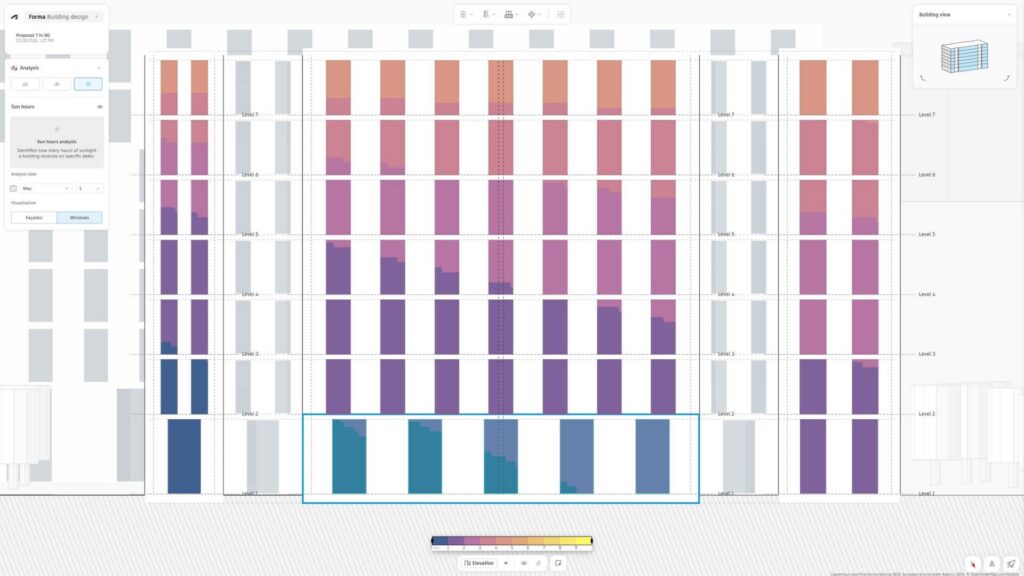
Tools like Forma Building Design are designed to enable more design exploration at the earliest stage of design thinking. Architects can quickly shape different options without overcommitting time to complex modeling. By integrating normally separate and complex analysis –such as daylight potential, sun hours, total carbon – in the design environment, it allows architects to test performance in parallel with design rather than sequentially afterwards. By front-loading analysis, it makes uncertainty visible while there’s still room to respond to it.
For a multifamily project, this means for example:
- Testing how incremental five-foot adjustments in a courtyard width affect daylight access across stacked units — at what point does a courtyard become just a lightwell?
- Comparing corridor configurations to optimize circulation space and compliance for egress.
- Identifying the facade design that best balances passive solar gain with views and privacy.
When performance feedback is immediate, the cost of testing an idea drops dramatically. Teams can take more time to explore more options. Trade-offs become visible rather than theoretical. And the final scheme — whichever direction it takes — is grounded in evidence that supports initial intuition.
The case for deeper design exploration
Schematic design has always been where the most important decisions are made. What’s changing is the capacity to test those decisions rigorously before committing them.
For multifamily residential — where unit efficiency, daylight quality, energy performance, and financial viability all meet in the earliest design decisions — that capacity for exploration matters.
Tools that reduce the friction around design iteration don’t change what architects are trying to do. They give architects more time and room to do it well.
Curious to try Forma Building Design? Register for the closed beta here.