 Jesper Staahl
Architects and AI was the name of the one-day conference organized by the Association of Consulting Architects in Norway, known internationally in part for their Nordic Open Letter to Autodesk. As a Norwegian architect myself I am in no little part proud to be part of this community of highly technologically advanced architects.
When the technological winds of BIM blew over the land, the Nordics became the sandbox in which technology companies such as Autodesk came to learn. A small, homogeneous group of architects, recently out of an economic recession, with plenty of highly trained professionals looking to retrain and re-educate in anticipation of better times, the Nordics proved to be a great arena to see what happens if the building industry actually took the leap from CAD to BIM. Norway stands as one of the most BIM-adopted countries in the world, and has done so for twenty years.
And now the winds of change are again moving across the industry, this time with AI arriving alongside a profession recovering from global lockdown.
Enough with the windy metaphors. Here at Autodesk we have a lot of listening to do, so that is what we did. We were offered the opportunity to present our perspectives on AI in the industry, but more importantly we wanted to come and listen. So that is what I did.
Experimentation: Architectura Synthetica
The conference presented the conclusion of an ambitious open architectural competition inspired by our creative sisters over in media and entertainment. Cinema Synthetica reimagined as Architectura Synthetica , an AI-only 48-hour competition pushing the boundaries of what might be possible with AI, in an extremely limited competition timespan.
The contestants were judged on method, documentation and outcome equally. Among the finalists were architect students and professionals like Espen da Silva and Erling Haaversen (Hille Melbye) , building adversarial AI-agents negotiating separate fields of interest until they could converge on a single design intent. And Tatjana Rebic (Witte Sundell) who created an AI workflow that turned one architect into a process-driven force majeure.
The winning team, a curiously grounded architectural process by Torkel Englund (interior architecture student, UiB) and Fatin Radi (Studio Radi), leveraged AI at a level that felt almost naïve in its restraint. Howver the outcome resonated most closely with architectural reality. And ultimately as it turns out, making it real for the judges on out in the end.
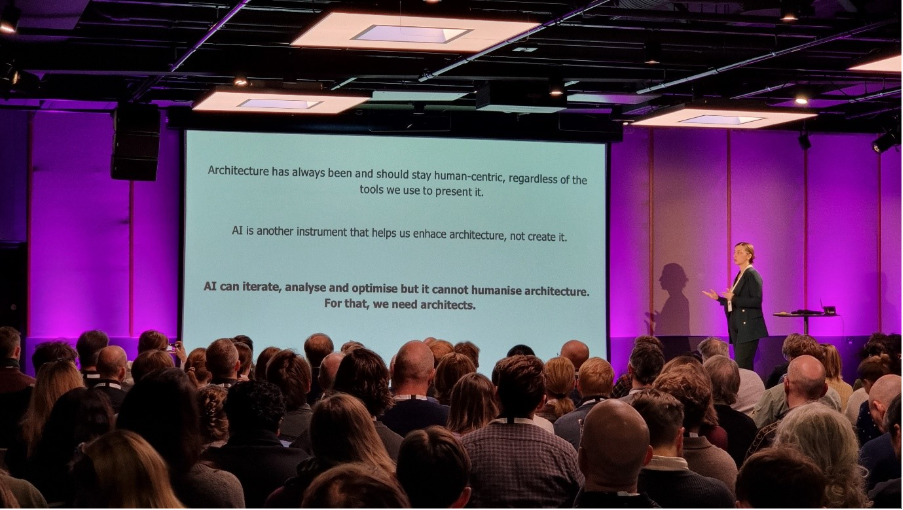
Cultural and Academic Framing of AI
The next segment was a smorgasbord of how academia, art and creative practices are approaching AI. Academic think tank MishMash is researching the impact on law, copyright, governance, IP, data training and ownership in the age of AI, especially within creative and cultural industries.
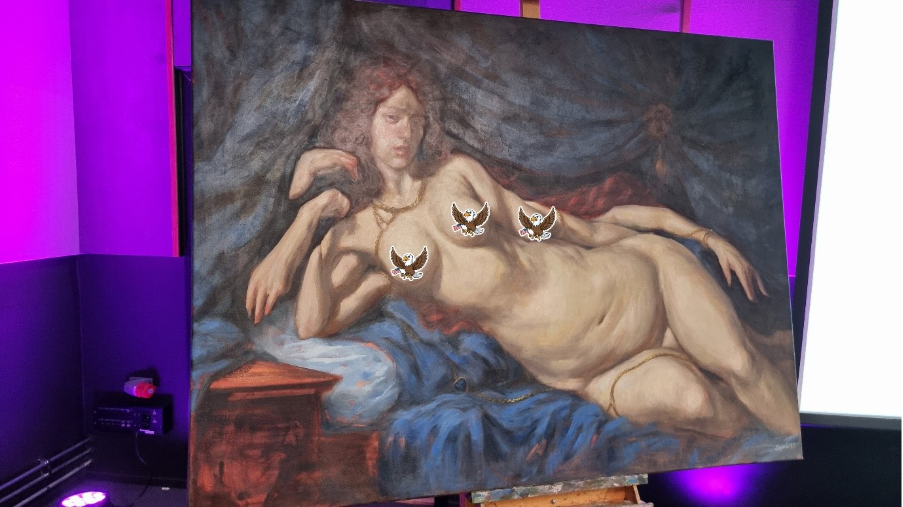
A delightful presentation by artist Siver Lauritz was perhaps the cultural highlight of my day. He treates AI not as an efficiency tool, but as artistic material. His merger of a Snøhetta reference architecture with 3D models, a livestream of his webcam of his own hand was only overshadowed by an installation where he prompted outputs from early-generation language models to create morphing forms of the human body, later translating them into oil paintings on physical media for his exhibition.
AI, in this framing, was not automation. It was authorship, interpretation and critique.
Practice-Level Response: A Structured Approach
Following this was an extremely sober presentation by technology-pragmatic firm ASAS Arkitektur, and how they, as a small 25-person practice, are navigating what they described as the approaching flood of AI.
Their approach is structured and deliberate. A small special interest group is nominated to spend a salaried, non-billable, amount of hours every month exploring, learning, reporting and educating the office on possible applications of AI in their day-to-day practice. From reducing administrative overhead to visualization workflows and beyond.
An extremely quotable presentation by Ola Spangen and Marius Erikstad perhaps captured the most balanced summary of the day:
“We don’t have time. We don’t have competency. And perhaps we don’t actually have a desire for it. But we need to keep on top of this.”
When it comes to AI, nothing resonates with me more than that right now.
Responsible Growth and Measured Commitment
Amongst other software companies, our own Lauren Poon and Andrea Vallés presented some of the AI features we are previewing in Revit 2027 at the event as well.
It is tempting to overstate what AI will deliver in the near term. That would be premature. The industry is still experimenting. Many workflows remain unstable. Governance frameworks are evolving. Adoption varies widely between firms. Autodesk’s responsibility is not to promise transformation overnight, but to invest in infrastructure, interoperability and responsible deployment. That includes:
- Supporting open integration.
- Strengthening platform foundations.
- Enabling firms to adopt AI at their own pace.
The goal is to enhance and amplify architectural judgment, and to extend capability where it provides measurable value.
The AI Manifesto: Recentering Architectural Values
Lastly, and perhaps most importantly, the Association of Consulting Architects presented their draft AI Manifesto. The closing session, led by Angie Mendez (Multiconsult / A-lab) together with Maria Makri (DARK arkitekter), reframed artificial intelligence not as a trend but as a structural turning point for the architecture profession.
The manifesto recentered the audiences’ focus on core architectural values. It argues that AI exposes existing systemic weaknesses in architecture and called for non-negotiable principles: protecting learning by doing, defending human intent over algorithmic probability, demanding transparency and data sovereignty, rejecting cultural bias in global training data, maintaining mentorship and craft, and shifting from selling hours to selling impact.
AI-generated content was defined as a basis for design rather than design itself, alongside a call for architects to develop critical AI literacy, including knowing when not to use AI, and grounding its use in democratic, human-centric principles. Nature as our ever-present client.
So there you have it. Architects and AI.
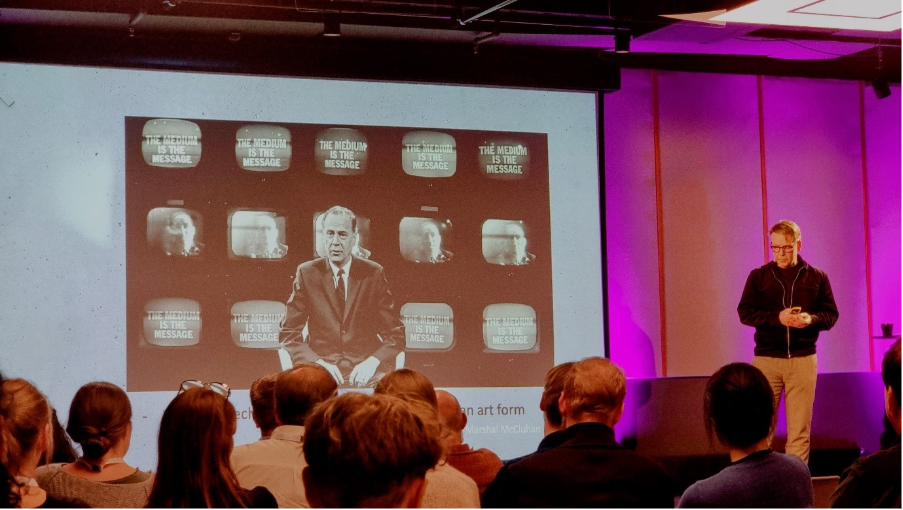
I sensed a shift in the wind, a profession leaning forward with sceptical optimism and curiosity. I felt inspired.
As for Autodesk’s role in this, it is about listening. About finding ways to enable architects thoughtfully and responsibly. I am glad we were there in the room, for all of it, to listen and learn, and to continue supporting architects as they define how AI should serve their work.
Because with Autodesk, you should find a partner that has the time, the expertise and the desire to make AI work for architects and the AEC industry.
About the blog post and author
Speaking of AI transparency, here is how I used AI to help me stay focused at this conference:
ChatGPT 5.2 received my handwritten notes as I listened to the sessions. It was made aware of the agenda page, helping root my notes to the correct session across the day. It provided session-by-session breakdowns at the end of the day. My writing is my own. My secretary was AI.
I also let ChatGPT generate a Slack-friendly summary ready to share with colleagues immediately after the event. Danish, Norwegian, American and Australian architects and developers read the summary as I was still commuting from the event.
Video editing was done using Adobe tools and Kling 2.6 Pro.
The bald eagle nudity stickers were prompted using Gemini for a cheap gag at the expense of my American colleagues. I am sure they could be printable on demand. I will call them copyright-free, CC0.

Jesper Staahl is a licensed architect in Norway (MNAL) and works in marketing at Autodesk, straddling the world between tech and architecture. Tech optimist. Cautious sceptic to AI. I just want better tools.