 Beth Foster-Chao

Mainstreaming clean cooling solutions to urban heat islands
Image courtesy of RMI
Of all the climate risks facing the world today, extreme heat may have the greatest potential to threaten human health. It is already having real, life-threatening consequences, especially for the more than one billion people living in informal settlements around the world.
In many tropical cities, temperatures are pushed even higher by the urban heat island effect and the use of housing materials like tin and cement that trap heat indoors. With limited access to reliable electricity, air conditioning is out of reach for most. In some communities, fewer than 5 percent of households own a cooling device.
For families in these areas, dangerously high indoor temperatures, day and night, are becoming the norm, putting young children, the elderly, and others at heightened risk.
Why RMI?
The Autodesk Foundation is proud to welcome the Rocky Mountain Institute (RMI) to the Health & Resilience portfolio. RMI’s global climate tech accelerator, Third Derivative, has launched an initiative to bring Passive Daytime Radiative Cooling (PDRC) to the communities most impacted by extreme heat. Passive Daytime Radiative Cooling technology refers to materials and surfaces that not only reflect sunlight but also emit heat energy through the atmosphere and out into space in the form of longwave infrared radiation.
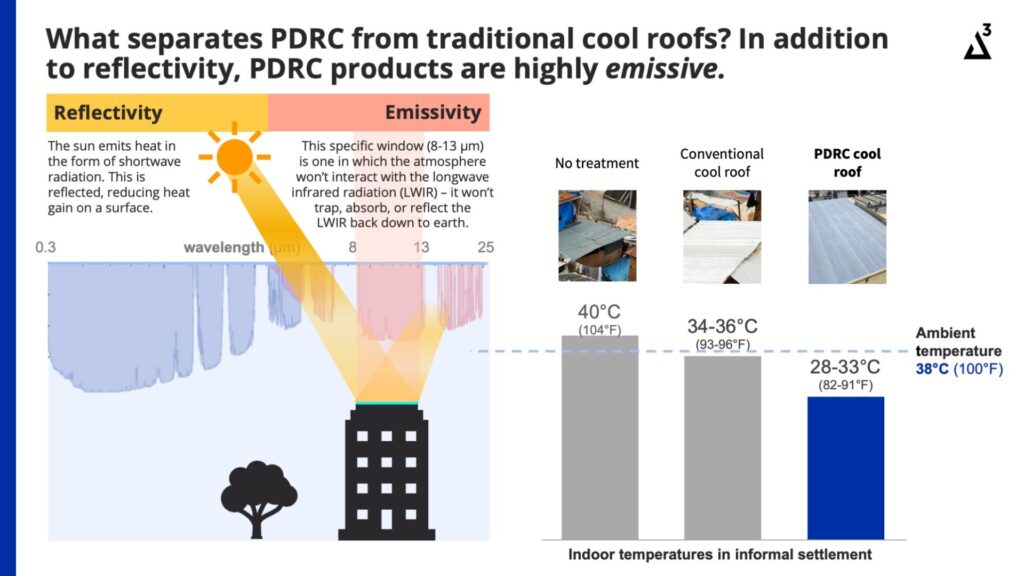
Image courtesy of RMI
Considered a “clean” cooling technology, PDRC have the potential to lower roof surface temperatures by up to 90°F and indoor air temperatures by as much as 18°F without electricity, with minimal maintenance needs, and at a fraction of the cost of air conditioners. In addition to the significant benefits to indoor comfort, PDRC can help reduce the urban heat island effect by lowering air temperatures in urban heat zones.

Image courtesy of RMI
Until now, PDRC has been limited to commercial or high-income residential applications. RMI is working to change that. Their plan starts with real-world pilots in informal settlements in India, where not only product performance will be monitored, but also human health In doing so, they are helping to mainstream this technology, support product commercialization and cost reduction through economies of scale (products are currently early in development), and drive affordable adoption where it can have the greatest human impact.
The long-term vision is bold:
reach 80% of informal and low-income homes in high-heat countries within five years.
“The clean energy transition must work for everyone, everywhere — that means accelerating solutions that deliver both impact and resilience,” said RMI CEO Jon Creyts. “With the Autodesk Foundation, we are harnessing the power of innovation and collaboration to create scalable pathways for vulnerable communities most exposed to extreme heat. This is how we unlock a cleaner, more prosperous, and more secure future for all.”
Our collaboration
Through our partnership, RMI will explore using Autodesk technology like AutoCAD, Revit, and Insight to accelerate their work in this sector. The team will also leverage other offerings including technical expertise to help analyze results, model impact across other geographies, and visualize pilot findings.

“RMI and Third Derivative are excited to kick off this new partnership with the Autodesk Foundation, one of the most respected leaders in our global effort to make the built environment safer, healthier, and better for the planet. Autodesk, RMI, and D3 have distinctive and complementary capabilities at the intersection of building technology, material science, design, and construction.
Together, we have the opportunity to deliver immediate relief to vulnerable, heat-stressed communities in India while building lasting climate resilience across the globe.”
– Rushad Nanavatty, Managing Director, Third Derivative
Access to cooling should not be determined by income or geography. With the right technology and the right partners, we believe it’s possible to close the gap and deliver climate resilience to the people who need it most.
Learn more about how RMI’s Third Derivative program is tackling extreme heat. For organizations developing Passive Daytime Radiative Cooling (PDRC) solutions, apply to join their U.S. pilot projects here.