 Jeanne Tan
Autodesk Forma, available in the AEC Collection or as a standalone subscription, offers powerful AI-powered tools for architects and designers in pre-design and schematic design phases.
Early, informed insights during the design phase are crucial for achieving sustainable outcomes in architectural and urban planning projects. Leveraging advanced yet easy-to-use tools like Autodesk Forma not only facilitates these early insights for architects but also makes the process accessible for everyone involved.
This blog post based on the Autodesk University 2024 class From Concept to Carbon: Early Design Insights with AI and Autodesk Forma, demonstrates how Stantec tested Forma’s embodied carbon analysis–a built-in embodied carbon calculator–on a large-scale, transit-oriented development project in Vancouver to successfully reduce embodied carbon from buildings.
Dynamic collaboration and real-time insights
One of Forma’s advantages is its ability to provide real-time feedback for architects and designers. Traditionally, life cycle assessments involve extensive analysis using third-party software, often requiring days to weeks to complete due to project complexity and specialist knowledge. It’s a time-consuming process where information typically flowed from the architect to various disciplines and the sustainability team, who then conducted analyses and shared results back.
With Forma’s cloud-based design platform and embodied carbon analysis, interdisciplinary teams can collaborate live as the design evolves. They can view and iterate the same model, run real-time embodied carbon analyses, and interpret results together instantly. This enables them to quickly understand the impacts of different design options on embodied carbon and make informed decisions together to reduce impact. “The exciting developments with Forma’s embodied carbon analysis is that it allows for much more dynamic interactions among the architects and the rest of the project design team members,” says Jay Burtwistle, Sustainability Consultant at Stantec.
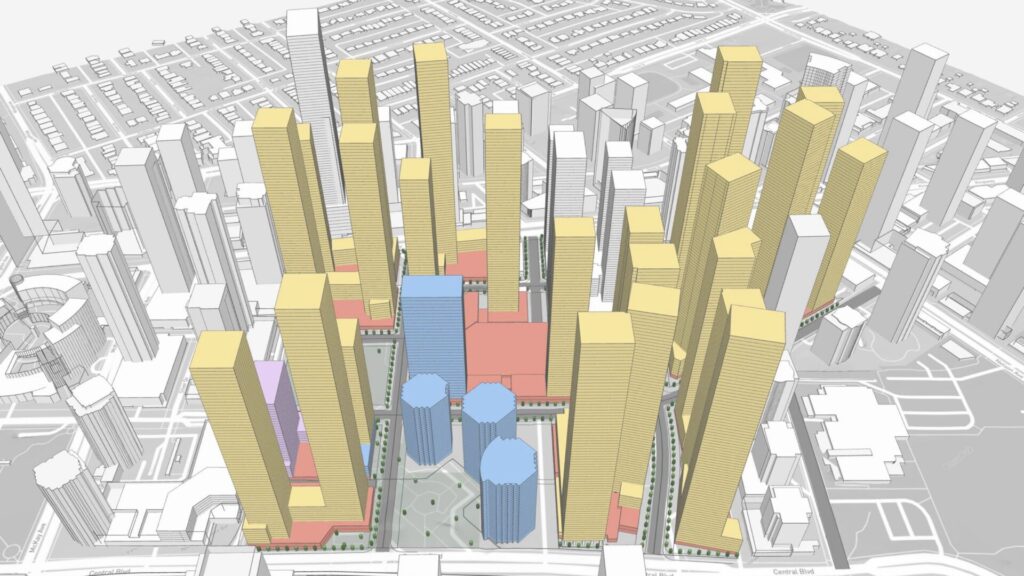
How to calculate embodied carbon: case study, Vancouver
The Vancouver project encompasses more than 20 proposed towers on an infill commercial site, including residential, commercial, retail, and hotel. In Forma, the team optimized the massing and building heights according to the brief, site restrictions, and living qualities such as daylight and sun.
For the structure and envelope, the Stantec team established these baseline conditions:
- A hybrid concrete structure
- Glass-fibre reinforced concrete (GFRC) cladding
- 50% window-to-wall ratio
- Mixed-use residential and commercial
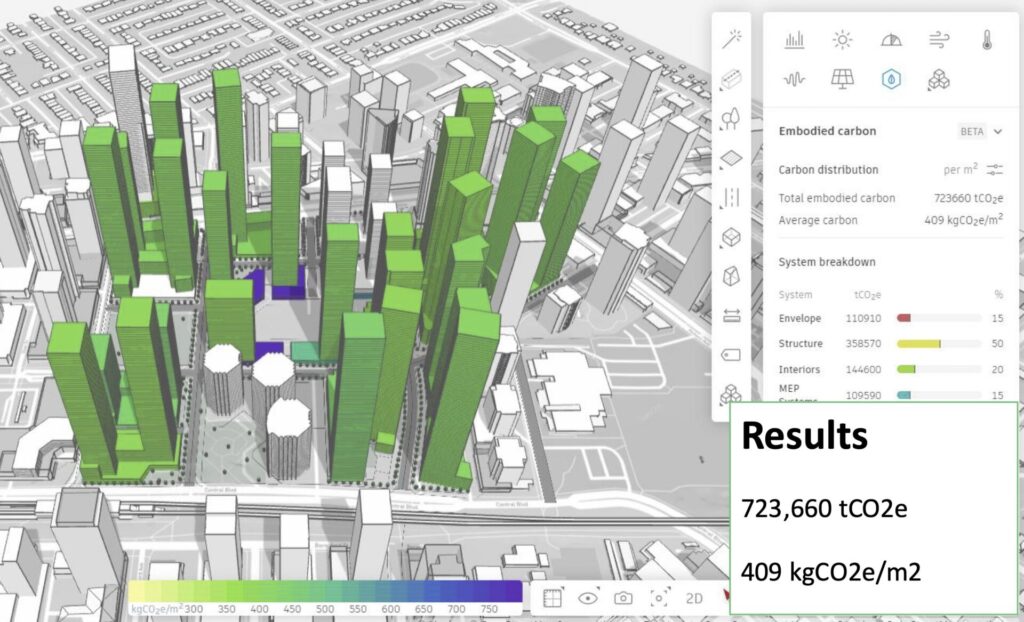
Using these initial settings, Forma’s embodied carbon analysis predicted the total embodied carbon at 723,000 tons of CO2.
The carbon intensity (kg/m² CO2) averaged at 409 kg/m² across all buildings. This average provides a baseline for the team to compare designs easier to see the better-performing options immediately and pick the best proposal to move forward with.
Empowering design teams to make data-driven decisions
Despite being first-time users, the team found Forma intuitive and easy to use, quickly getting up to speed and making iterations in about an hour and a half. They could select multiple buildings, tweak the design, and run analyses within seconds. The visualized results highlighted the relative embodied carbon impact of each building in a clear and simple way using colour gradients. “It was quick–about 5 to 10 seconds to run the analysis. We’re able to click on that button and we get our results,” says Burtwistle.
Incorporating mass timber for reduced carbon footprint
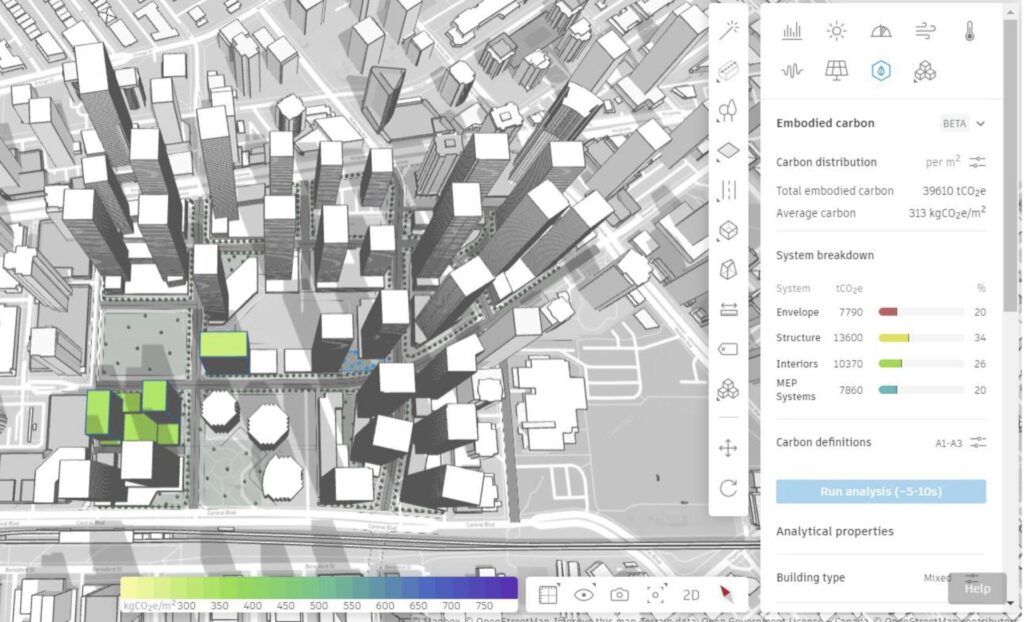
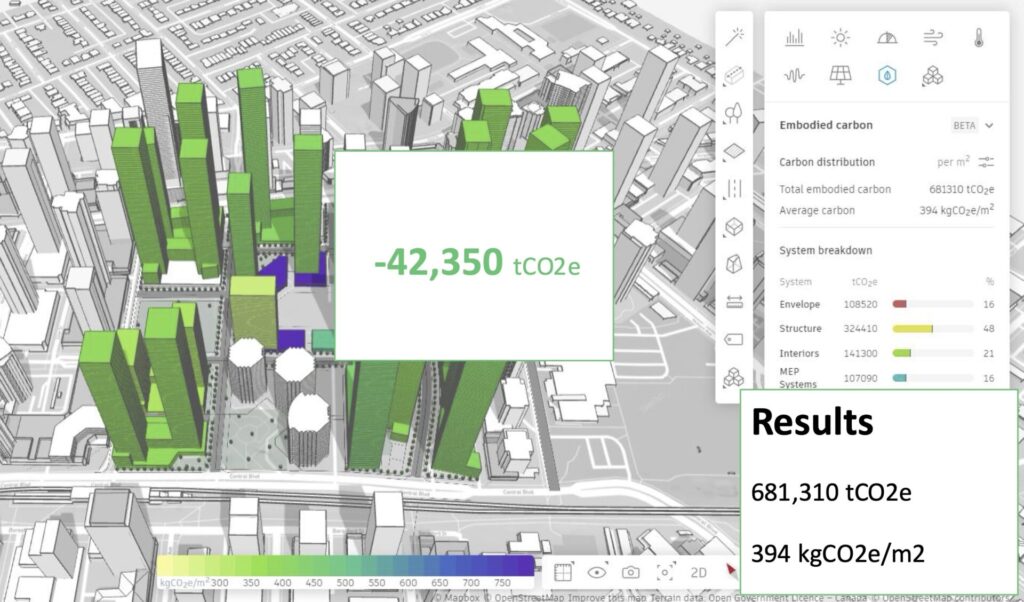
In a bid to further reduce embodied carbon, the team switched the structure from hybrid concrete to mass timber for the three shortest towers: the office tower, a residential tower, and hotel. This reduced the carbon intensity for these buildings alone significantly, lowering the average to 394 kg/m² and bringing down the total project embodied carbon to 681,000 tons–a reduction of 42,000 tons of CO2. “That’s about a 15 kg/m² drop across the whole site just from shifting those three towers,” adds Burtwistle.
Scaling lessons across projects and teams
Both the client and Stantec teams were enthusiastic about these outcomes that show how quick, early modelling can help achieve significant embodied carbon savings at an early design stage. With this case study, Stantec takes these lessons forward to set the stage for educating design and sustainability teams across the firm and optimizing sustainable design practices across other projects.
Imagery courtesy of Stantec.