 Brandy Ryan
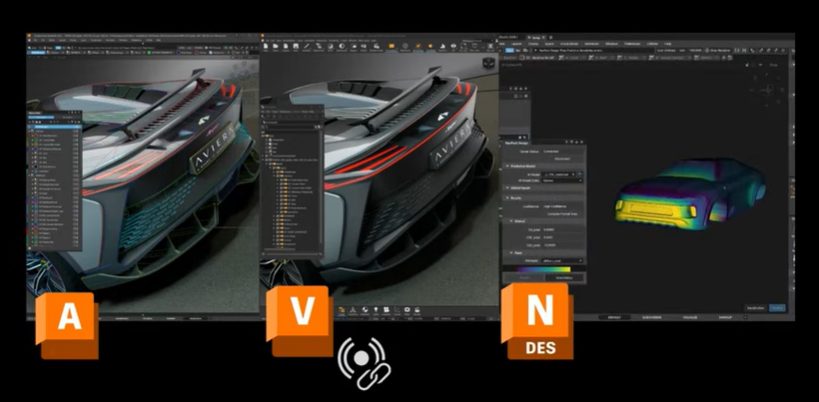
How Alias, VRED, and NavPack connect design, visualization, and engineering through real-time physics insight.
We’ve got a new NavPack webinar for you on the Autodesk Design Studio YouTube channel. It explores how automotive teams can bring real-time engineering insight directly into creative workflows, without disrupting your established design and visualization processes.
This session, with host Jousef Murad and experts Jakob Lohse and Barry Kimball, demonstrates how Alias, VRED, and NavPack work together to support faster, more informed collaboration between design and engineering.
Watch the full webinar on the Autodesk Design Studio YouTube channel.
What happens when physics enters the design conversation
1. One model, multiple disciplines
The webinar shows how a single Alias design model can be live-referenced into VRED for visualization and connected to NavPack for engineering insight—eliminating handoffs and preserving a shared source of truth.
2. Left-shifting engineering insight into design
NavPack enables designers to access aerodynamic predictions directly inside Alias, allowing teams to evaluate performance impacts in real time and make informed decisions earlier in the process.
3. Physics AI trained on real simulation data
Rather than relying on generic models, NavPack is trained on each organization’s own high-fidelity simulation data, transforming legacy datasets into reusable engineering intelligence.
4. Transparency through uncertainty visualization
Calibrated uncertainty maps clearly indicate where predictions are reliable and where geometry falls outside the model’s training domain, which helps designers know when to proceed and when to involve engineering.
5. Predictive and generative AI in the same loop
By combining predictive insight with generative variation, Navpack supports rapid exploration of multiple design directions, enabling teams to narrow in on promising concepts before committing to detailed refinement.
Your NavPack questions, answered
Does NavPack replace CFD or FEA?
No. NavPack accelerates access to physics insight earlier in the workflow, while simulation remains essential for validation, edge cases, and expanding the model’s knowledge.
What does surface uncertainty indicate?
Surface uncertainty highlights areas where predictions may be less reliable because the geometry falls outside the AI model’s training domain, guiding teams toward additional simulation when needed.
How much data is required to train a model?
The amount varies by use case. Simple variations may require only a small dataset, while complex geometries and fine-grained changes can require hundreds or thousands of simulations.
How accurate are NavPack predictions?
When trained on high-quality data, NavPack predictions closely match CFD trends and patterns, often within the inherent noise of the simulations themselves.
By embedding Physics AI directly into Alias and connecting design, visualization, and engineering workflows, NavPack enables teams to collaborate more effectively and make better-informed decisions—earlier, when change is still inexpensive.
This story was developed using a blend of human expertise and AI tools supporting the research and drafting. Our team shaped, edited, and fact-checked the final content to ensure accuracy and alignment.
Looking for more NavPack content? We’ve got a kick-off story going into how NavPack came into being, two AIF 2025 presentations that offer both a high-level entry point and a deep dive into how it all works, and a quick overview of what NavPack offers.
Check out our Autodesk Automotive on LinkedIn and visit the Design Studio YouTube channel for product updates, resources, and more.

Sharpen Your Skills
Alias and VRED Learning Editions are free for non-commercial use. Learn more and start your journey today.