 Autodesk Media & Entertainment
AI is unlocking extraordinary new possibilities in media and entertainment. It’s accelerating creative workflows, powering real-time localization, and even suggesting story edits. For producers and production technologists, it’s a game-changer – compressing timelines, cutting costs, and giving artists superhuman creative reach.
But with every new capability comes a new question: What’s the risk of that convenience? Because while AI can amplify creativity, it can also endanger it if not managed properly.
Creativity evolves. So should security.
Explore “Safeguarding Creative IP in the Era of AI and the Cloud” – a deep dive into how studios can protect their ideas, assets, and artistry in an AI world.
The double-edged nature of AI in production
AI isn’t a fad. It’s a foundational shift in how creative work gets produced. Studios are already experimenting with AI-assisted editing, color grading, asset tagging, localization, and quality control. Game developers are training models to populate worlds with assets and NPC behaviors. These tools are evolving at lightning speed – and so are the risks.
A few years ago, the biggest IP concern was keeping footage from leaking before release. Now, you also have to ask:
- Was that image generated from someone else’s copyrighted material?
- Did a model trained on your unreleased footage just memorize it?
- Could an AI-assisted edit obscure authorship or attribution?
In other words, the threat landscape isn’t only external anymore. Some of the most serious vulnerabilities now originate inside the creative process itself.
When innovation outpaces governance
AI systems don’t aim to create risk – but they often do, simply by being fast, opaque, and hungry for data.
Most generative models are trained on massive datasets scraped from the internet. Buried inside those sets may be copyrighted works, trademarked characters, or even confidential production materials. When those datasets are used to generate new content, traces of the originals can surface in the output.
The legal and ethical implications are still being defined, but the practical risks are already here:
- Unintentional IP infringement: A generative model might reproduce protected elements of another artist’s work, exposing your project to claims of misuse or plagiarism.
- Loss of attribution: When an AI tool edits, replaces, or generates content, who owns it? Who gets credited? Who gets paid?
- Deepfakes and synthetic media: Hyper-realistic renders can be misused – sometimes maliciously, sometimes accidentally – to mislead audiences or misrepresent performers.
- Data leakage: Training internal models on unreleased footage or scripts can cause that material to resurface later in ways no one intended.
- Pipeline vulnerabilities: Every AI plug-in, API, and cloud connection expands the potential attack surface.
- Bias and brand risk: When models reflect bias in training data, the results can erode audience trust and damage reputation.
These aren’t theoretical concerns. They’re already showing up in contracts, insurance policies, and post-mortems.
The paradox of control
As production leaders, you’ve probably noticed the paradox: AI promises more control – over efficiency, budgets, and creative options – but often delivers less control over where data goes and how it’s used.
That’s why “workflow integrity” now means something new. It’s no longer just about keeping shots in order or protecting versions from corruption. It’s about ensuring that the final product truly represents your creative intent – and that the process of making it doesn’t compromise your IP, your brand, or your audience’s trust.
The question is no longer simply: “Can someone steal our IP?” It’s: “Can we accidentally compromise it ourselves?”
Managing AI responsibly
You don’t have to slow innovation to stay secure – you just have to approach AI adoption intentionally. That starts with visibility: knowing which tools are in your pipeline, where they connect, and what data they touch.
From there, several best practices are emerging across the media and entertainment industry:
- Map your AI ecosystem. Inventory every tool, model, and service – internal and external – that interacts with your content. You can’t secure what you don’t know exists.
- Set boundaries for model training. Keep unreleased or proprietary material out of shared or third-party training sets unless you have explicit safeguards and legal clearance.
- Track provenance. Establish systems that record who (or what) created, modified, or approved each asset. Provenance logs are becoming essential for audits, licensing, and compliance.
- Harden your pipeline. Treat AI APIs, plug-ins, and integrations as critical infrastructure. Apply the same encryption, identity management, and access controls you’d use for your dailies or editorial systems.
- Adopt “Zero Trust” principles. Assume every user, system, and algorithm must prove its legitimacy – continuously. Verification beats assumption.
These practices are evolving quickly, but one principle remains constant: security has to move at the same speed as creativity.
Where Autodesk Flow Capture fits in
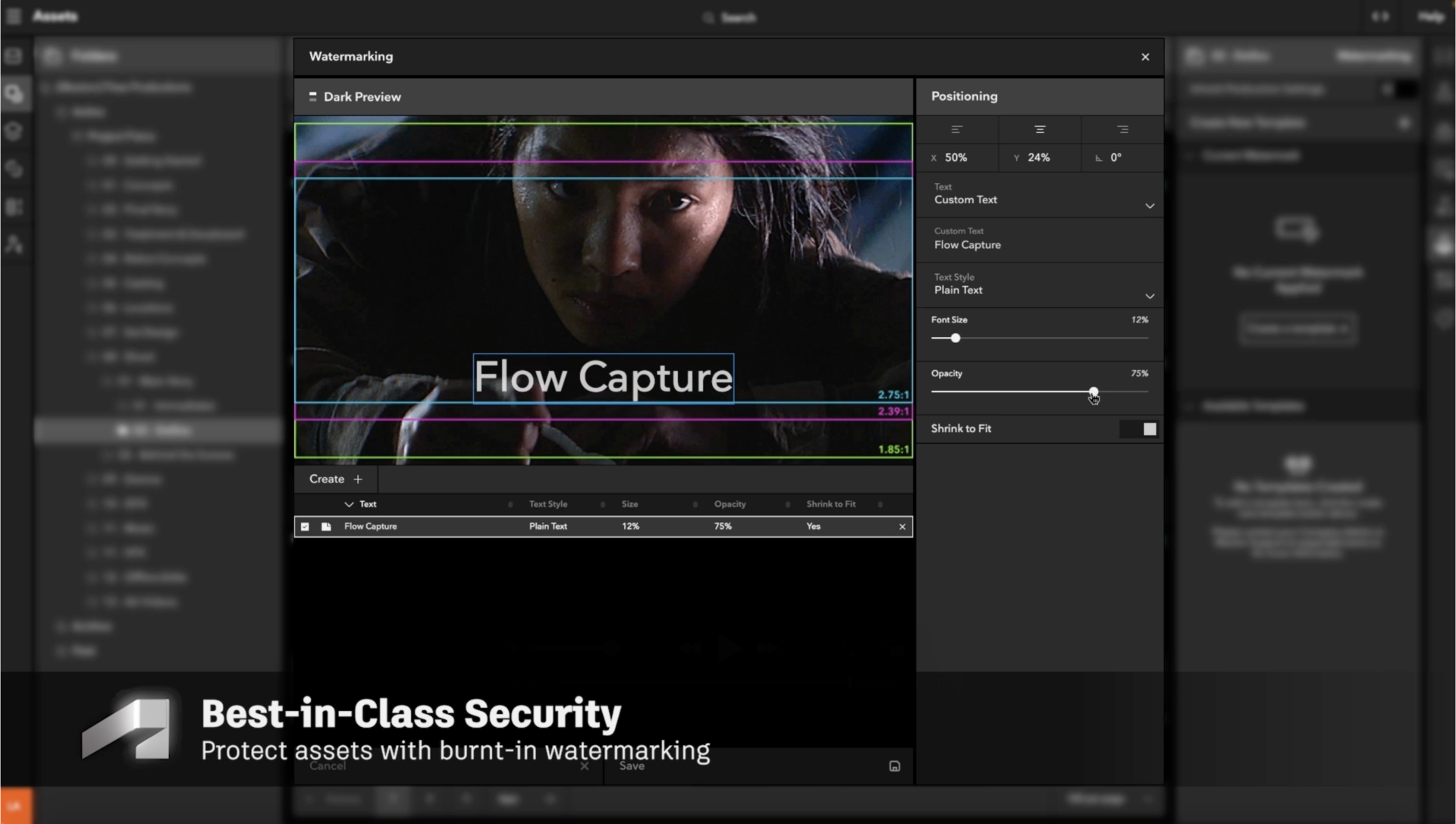
Autodesk Flow Capture is built for this challenge. Originally known as Moxion and PIX, Flow Capture unifies secure review, approval, and collaboration into one cloud-native environment. It’s where distributed teams can share and review creative work, confidently. And in an era where AI can blur authorship and data boundaries, that confidence matters more than ever.
Flow Capture helps address AI-driven IP risks by:
- Providing audit trails that record how and when AI-generated or AI-assisted content enters your pipeline—ensuring provenance and accountability.
- Enforcing granular permissions, so only authorized users and systems can access or modify specific assets.
- Operating within secure, compliant cloud infrastructure, protecting sensitive data and models from unauthorized use or exposure.
Beyond that, Flow Capture’s layered security approach – end-to-end encryption, MFA, role-based access, dynamic watermarking, forensic logging, and continuous compliance testing – creates a “secure-by-design” foundation for any modern production.
Its guiding principle: protect assets without slowing down creativity.
When all review, feedback, and approval happen inside Flow Capture, there’s less file shuttling between tools and fewer weak points for data leakage. It’s a unified system that scales with your workflow – whether your team is across the hall or across the ocean.
AI isn’t just the challenge – it’s part of the solution
Ironically, AI will also be one of the strongest tools in future security frameworks. Machine-learning systems are already helping detect anomalies, flag suspicious network behavior, and automate responses to potential breaches. As threats grow more sophisticated, “machine-speed defense” will become a vital part of any studio’s toolkit.
But that makes a strong foundation even more important. If AI is going to help defend your IP, you first have to defend your AI – its data, its models, and its access points.
That’s what Flow Capture delivers: the infrastructure to adopt AI confidently, securely, and transparently.
Partnering for the long term
No one can predict exactly where AI will take media and entertainment next. What we do know is that the pace of change isn’t slowing down. The tools you use today will evolve, the risks will shift, and the definitions of “authorship” and “ownership” will keep being rewritten.
Navigating that future requires more than software – it requires a partner that understands both the creative and the technical stakes.
Autodesk has spent decades building the backbone of film, television, and game production technology. We’re investing heavily in our own AI tools and security architectures so you can stay focused on what matters most: making extraordinary content.
The future of production will be defined by those who combine innovation with responsibility. With Flow Capture, you don’t have to choose between the two.
Want to learn more?
Download our white paper “Safeguarding Creative IP in the Era of AI and the Cloud” for deeper insights into how studios can embrace AI innovation while protecting every frame, file, and creative idea.