 Jesper Staahl
Forma Site Design, available in the AEC Collection or as a standalone subscription, offers powerful AI-powered tools for architects and designers in pre-design and schematic design phases.
TL;DR:
- Wind analysis: it’s easy for architects to evaluate wind conditions in Forma Site Design. Just start with a few forms you want to test, a question, and make it fun!
- Our experiment modelling five different high-rise towers, each with a specific strategy for wind stability, uncovered some surprises about their performance for pedestrian wind comfort.
- Spoiler: the twisted form seemed to be the clear winner for pedestrian wind comfort on ground level.
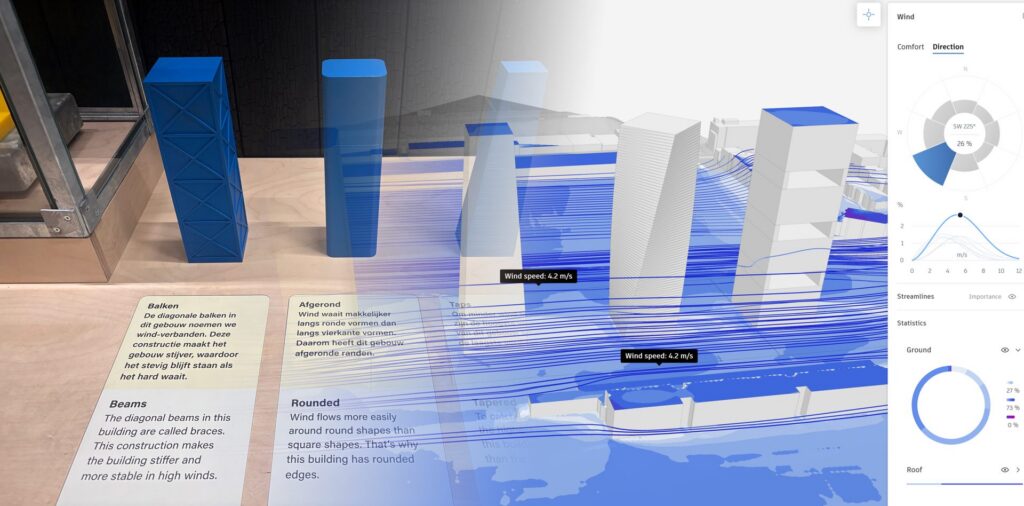
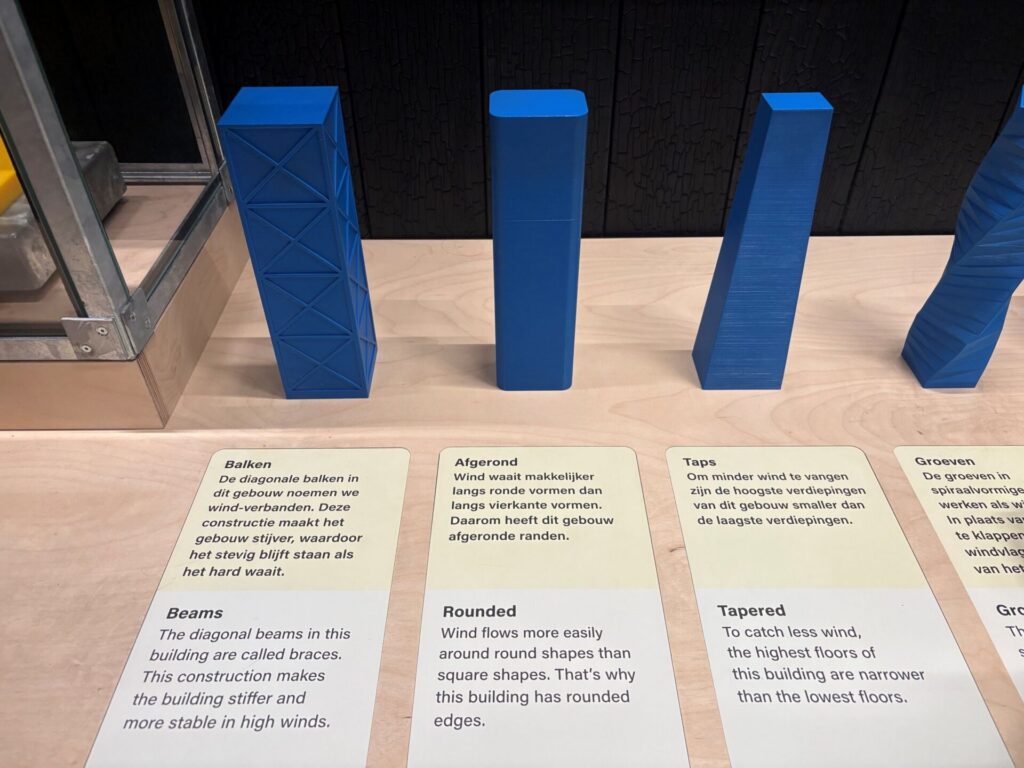
This was one of the exhibits we came across recently at the NEMO Science Museum in Amsterdam in the construction section. Technically it was aimed at kids, but it was equally fascinating to the architects looking at it.
The exhibit asked two simple questions: how do you build many homes on a small piece of land? Upwards! And since a high building is unstable in the wind, how can we help it stay upright so it doesn’t topple over?
We stayed at that exhibit longer than we probably should have.
The question the exhibit didn’t ask
The exhibit was designed to show structural performance – how a building’s shape determines its resistance to wind loads, for example through cross-bracing or rounded corners. It does that clearly. Intuitively it makes sense, but wouldn’t it be fun to see the action slipstreams of wind and how these shapes deflect, brace, or redirect wind?
And standing there looking at the different towers, we started thinking about a different question: what does this mean for the people outside the building below? The ones standing at the entrance, sitting on a bench eating lunch in the plaza, or perhaps waiting at the bus stop out front?
If form changes how wind behaves around a structure, it must also impact wind conditions on the street.
We wanted to find out. So, we took some photos with us back to the office.
Taking the experiment back to the office in Forma Site Design
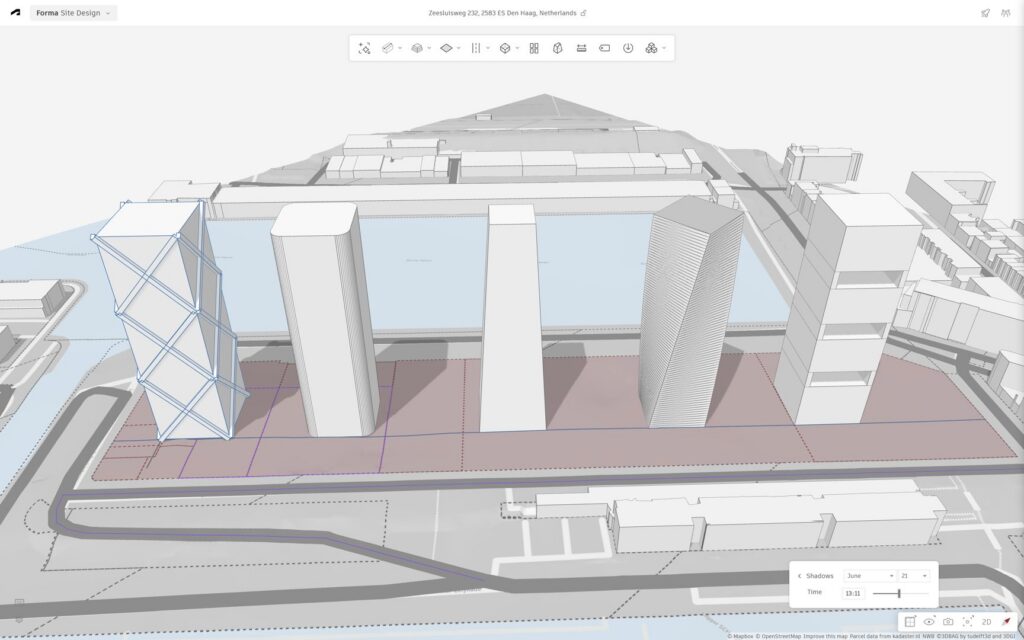
Back at our desks, we recreated the museum exhibit using Forma Site Design. We picked a windy, waterfront site in the Hague, the Netherlands, facing the North Sea – it’s an unlikely spot for a tall tower, but we wanted to subject these towers to as much wind as possible for this experiment. We then ran the Rapid wind analysis. Using machine learning, the AI analysis predicts almost instantaneous results to give quick insights into wind conditions, according to wind direction and pedestrian comfort. The predominant wind direction comes from the west, gushing in from the open sea.
We modelled the five tower typologies:
- A tapered tower that narrows as it rises, reducing its exposure to stronger winds higher up
- A twisted tower designed to disrupt and redirect airflow
- A cut-out tower with openings that let wind pass straight through
- A braced tower that achieves stability through diagonal structural framing
- A rounded tower whose curved edges encourage wind to flow more smoothly around the surface
What we found part 1: Using rapid wind analysis
After running the analysis on each building, we saw something unexpected: As much of a meme the “twisted tower” is in parametric design, you can clearly tell that the twisted tower outperformed the others. It creates higher pedestrian comfort on the ground floor by redirecting the wind up around its shape.
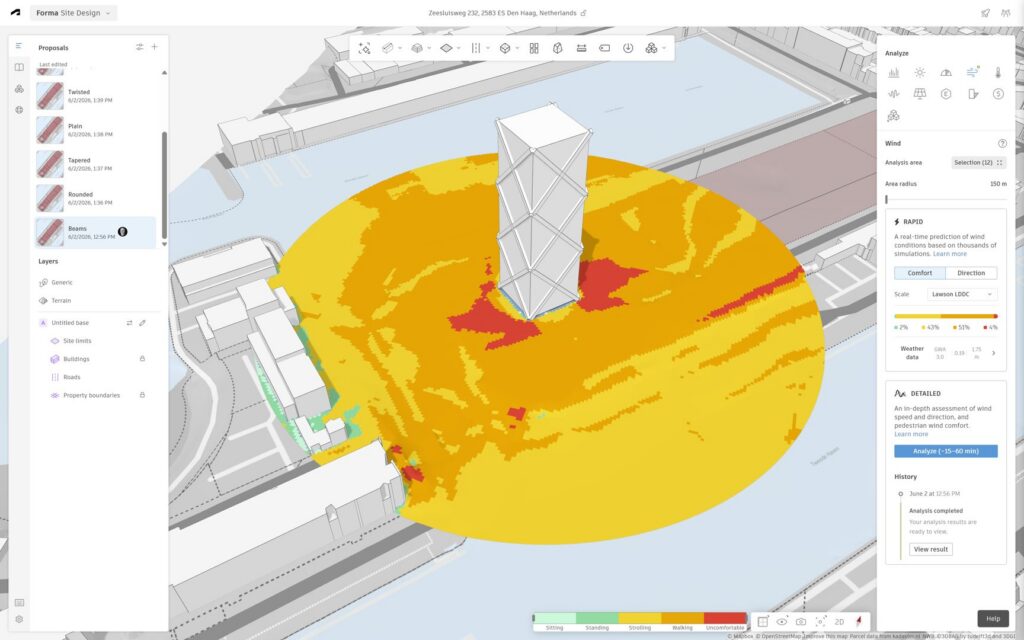
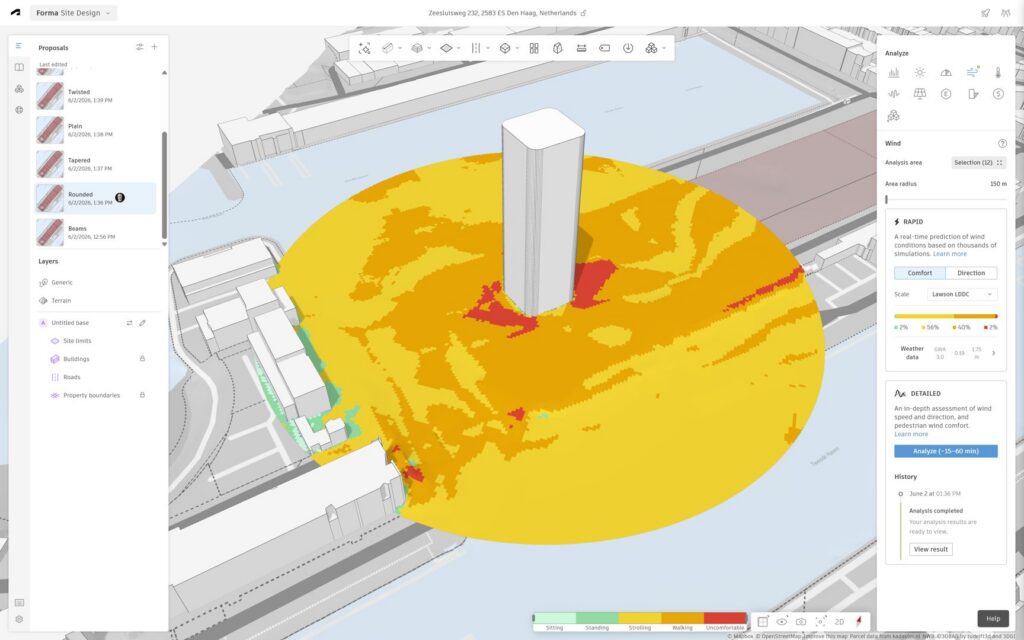
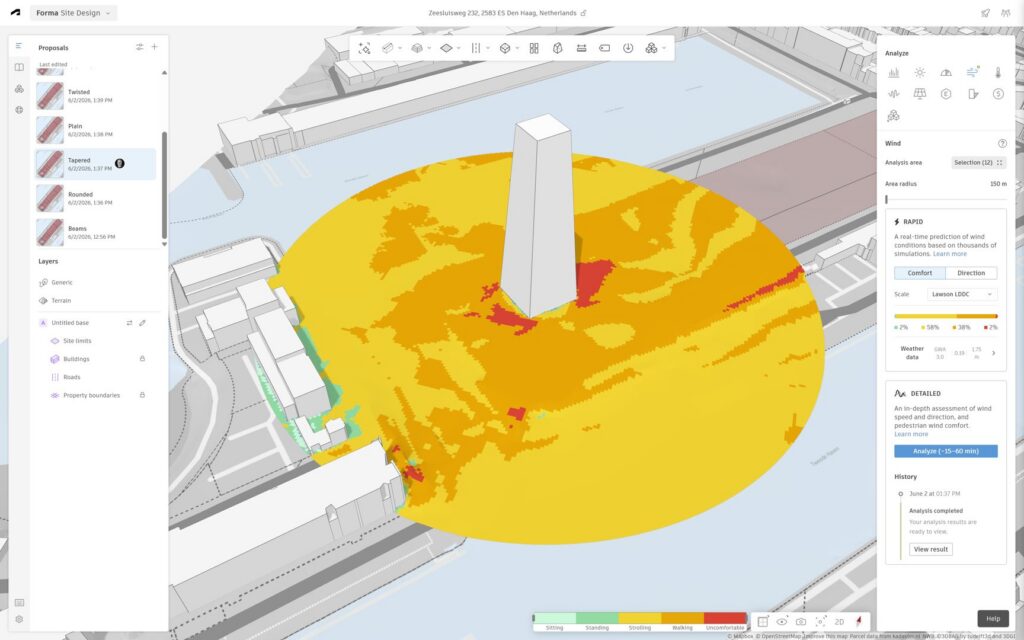
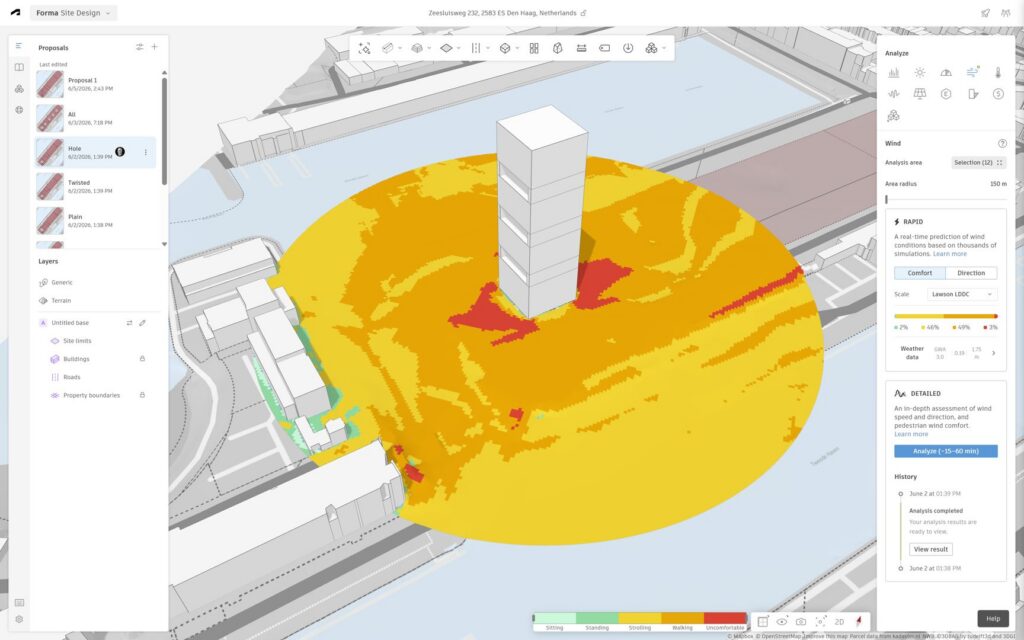
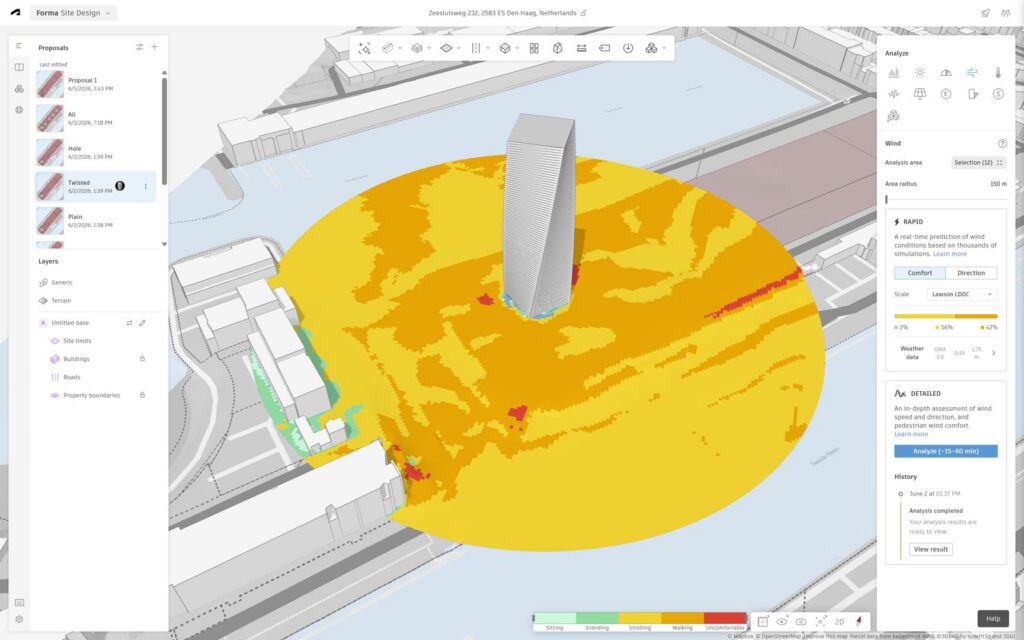
Each of these towers has a different strategy in dealing with the wind load to brace itself, but only the twisted tower appears to significantly increase pedestrian comfort on ground, at least at first glance.
Let’s dig deeper into these findings using Forma Site Design’s detailed wind analysis. A full eight directions computational fluid dynamics analysis ran on cloud servers, based on OpenFOAM (for you wind geeks out there) built directly into Forma Site Design.
What we found part 2: Using detailed wind analysis
Here is what we see when we ran the full wind analysis on all versions. Note that we also included a simple rectangular block as the baseline. Looking at all the alternatives in Forma Compare, all these shapes alter the wind comfort patterns on ground around the tower.
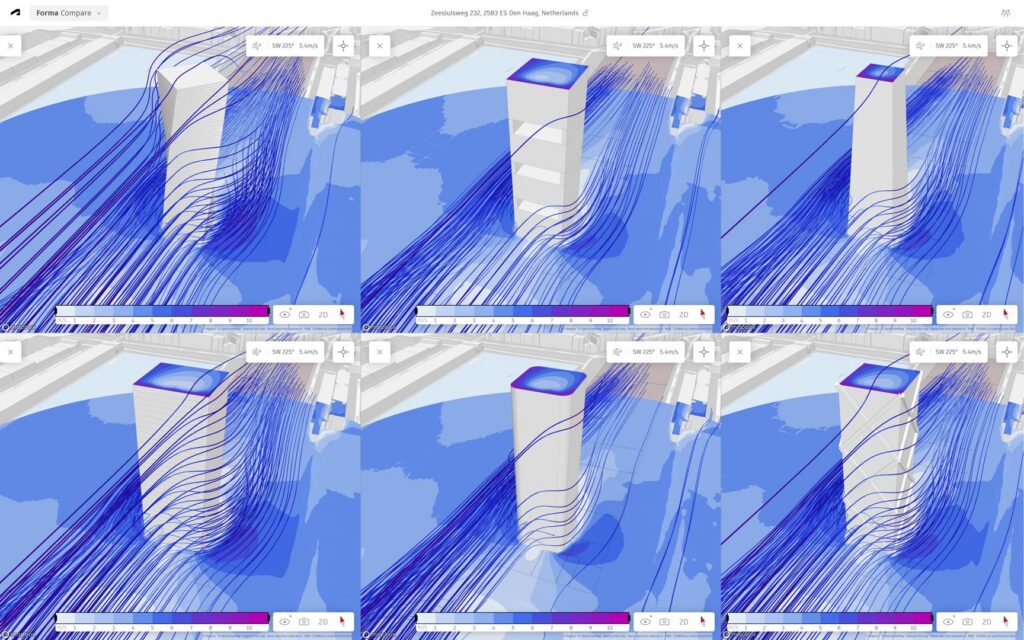
Below in the video, you can especially see how efficiently the cut-outs funnel wind through the building instead of pushing it down and around the base of the buildings. While the cut-out tower performs well from a structural perspective, a tradeoff to consider would be the reduced floor space to accommodate the cutouts.
You might recognize the use of cut-outs in high-rise projects around the world. Most notably perhaps the Shanghai World Financial Center (nicknamed the bottle opener), the so-called dragon gates of Hong Kong rooted in feng shui, 515 N. State Street in Chicago, and 432 Park Avenue in NY all feature this technique.
Assessing pedestrian wind comfort in parallel with structural integrity
The twisted towers, the curved corners, and the tapered tower shapes soften the wind and guide it through and up the buildings by virtue of their shapes, creating more favorable wind conditions on the ground for pedestrians. Cross-bracing is an effective engineering solution to stabilize the building against wind, but seems to do less to improve wind comfort for pedestrians compared to the others. So, the clear signals we picked up early in the predictive rapid wind analysis are now grounded in actual detailed simulations.
In our day-to-day work, having these fast insights into wind conditions – both predictive AI and detailed analysis – at the same time as we’re designing helps us see how each form reacts to its surrounding. We can weigh up their pros and cons easier in relation to our priorities. It helps us better understand and also clearly show others the reasons why we’ve made certain decisions, for example about the form of the tower or the safest and most comfortable zones to place, for example, the entrances or public seating areas. The main difference with how we traditionally is that we can do this analysis in parallel, while we’re designing, not after.
Closing the gap: Why early wind analysis matters
Did we discover something revolutionary? Something never seen before? Not at all – this is designing high-rise buildings for wind 101, but isn’t it nice to be able to see what actually happens when wind hits a building? Early wind analysis will never be a replacement for specialist wind engineers and structural engineers. Detailed expert analysis remains essential, and a rapid analysis is no substitute for that depth.
But I for one, am a visual learner, and visualizing helps me ground my architectural design decisions on actual environmental impacts – if I had my laptop with me, we could have even run the analysis at the museum cafe, right then and there.
What we’re interested in is closing this gap between early design and specialist study; and that gap is where a lot of consequential decisions get made. Massing choices. Orientation. Public space layout. By the time a wind engineer is brought in, many of those early decisions are often locked in and would be too costly to change.
Insights from these early analyses in Forma Site Design allow us to have better conversations with specialist engineers earlier while options are still open and changes can be easily made. It doesn’t replace expertise – it helps you arrive at the expert conversation better prepared.
The lesson that had nothing to do with wind
Children’s science museums are wonderful in that they make complex things easily understandable for everyone. Strip away the data and reports and what’s left is a simple question and a fun way to explore it.
Our visit to Amsterdam was a reminder of how useful it can be to step back from the screen, engage with something physical, and play with different ideas.
If you haven’t explored wind performance during early-phase design, it might be easier than you think. You don’t need a finished design or a specialist brief. Start with a few building volumes that you want to test (like the ones in this exhibit!) and a question. In the spirit of a kid’s experiment: keep it simple and remember to have fun along the way!
Oh, and if you find yourself in Amsterdam and want to catch the exhibit yourself, go check it out at the Nemo Science Museum, which was designed by Renzo Piano. Be sure to head up to the rooftop terrace for a drink and enjoy the view as well! There is something at the museum for the whole family, from budding scientists to curious architects, and maybe even an engineer or two.