 Autodesk Media & Entertainment
Season 7 of Netflix’s Black Mirror dives back into the tech-driven storytelling the show’s known for, from quantum computers that bend timelines to tools that can recreate vintage films. At No.8, a VFX studio based in the heart of Soho, London, that love of cool, forward-thinking technology really resonates. Together, the 70-strong team thrives on exploring new tools and workflows to push creative boundaries and get the best results as efficiently as possible.
Evren Olgun, Head of Film & TV, and VFX Supervisor, Pete Young, are two of the minds helping shape that culture. In this Q&A, they talk about what it’s been like joining No.8 after its recent acquisition of Jam VFX, their technical approach to projects, and what it meant to contribute to a show as iconic and creatively demanding as Black Mirror.
Q: Evren, Pete, introduce yourselves to our readers.
Evren: I’m Evren Olgun, and I’m Head of Film & TV at No.8. My background largely started in commercials as a bookings coordinator. Later, I moved into VFX producing, and I suppose things really took off at Jam VFX. At that time, Jam VFX was just a few of us working on high-end compositing for commercials. Then we got a breakthrough with a color facility we were working with at the time, which led to our involvement in Netflix’s The End of the F**ing World. Since our pipeline was originally built for commercials, the next 5 years were about establishing how we built film and TV projects, how we developed workflows and processes to manage much larger workloads and quantities of media.
Pete: I am a VFX Supervisor at No.8 London and have been in the industry since 2003, so 22 years. I studied Fine Art at foundation level and got an Honours degree in Graphic Design. I took the traditional route into VFX starting out running, then working my way through MCR, Combustion and then Flame/Inferno. After a while doing nightshifts and proving my worth, doing countless music vids and Roto prep, I was given the chance to run a Flame suite in daylight! From that point onwards I have had the honour of working with many amazing people at some great facilities including Clear, VTR/Prime Focus, Nice Biscuits, Big Buoy & finally Jam VFX (now No.8.) where now I feel I have found my groove.
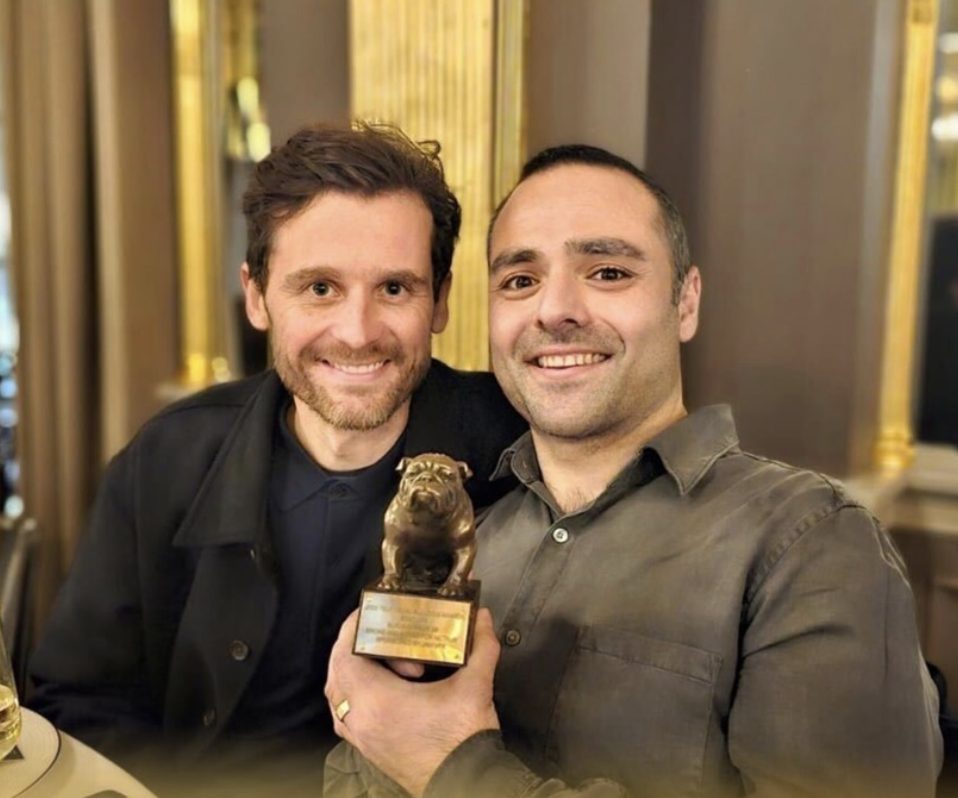
Q: So you guys recently joined No.8 as part of their acquisition of Jam VFX. How’s that going?
Evren, Head of Film & TV: It’s going really well. The timing was actually perfect. The acquisition happened just after we delivered Black Mirror, which gave us a bit of headspace to focus on integrating the two companies. We had two different pipelines, two different servers, two different cultures, so having that breathing room was valuable. And now we’re into the next phase, deep in post-production on a whole slate of new shows. It’s been a really positive transition. Being back in Soho has been lovely. The studio’s great, and there are some fantastic artists, producers, and people here. It’s just a really good vibe. One of the biggest changes is that we now have a social media manager, Olly Dawwas, who’s amazing. At Jam, we weren’t great at shouting about ourselves. We were always heads down, focused on the work. But having someone like Olly gives us a real voice.
Pete, VFX Supervisor: Yeah, it’s been great. Not just working with everyone but also being part of something bigger that’s focused on film and TV. I’m probably a bit of a film nerd, so it’s been really cool to get behind the scenes of shows like Black Mirror. I’ve watched that for years, so seeing how it’s made from the inside has been wild. Everyone’s integrated really well. We’ve got some big personalities now, which keeps things fun, and it’s just been a genuinely exciting step forward.
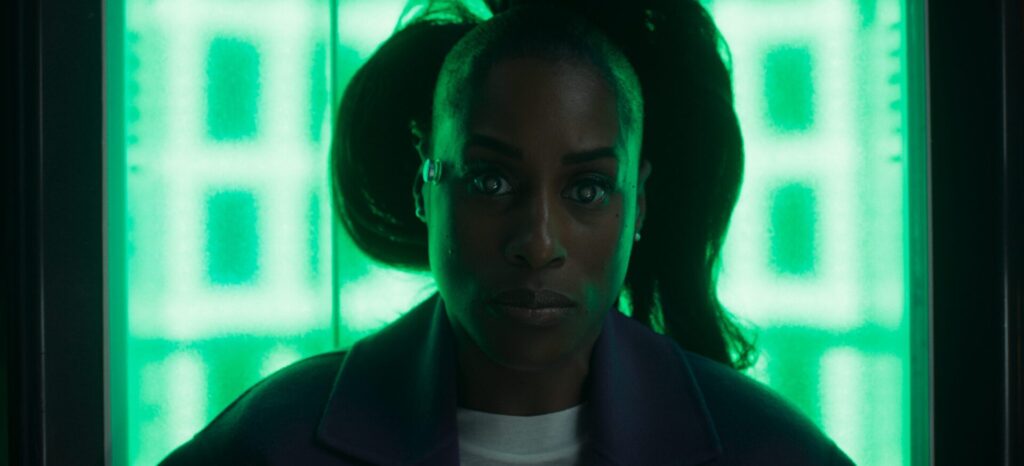
Q: You both mentioned Black Mirror, so let’s talk about it. What went through your mind when you learned you’d be working on Season 7?
Pete, VFX Supervisor: Being totally honest, it was a mixture of excitement and fear. Working on such an iconic show like Black Mirror that has such a devout following made me feel very nervous. I didn’t want to be ‘that person’ that messed ‘that episode’ of Black Mirror. I felt like I over thought everything. My personal insecurities and self-worth become a big demon for me and do make me question if I am up to the job. However, it’s important to look back and see that my 22 years of great work and happy clients can back me up.
Evren, Head of Film & TV: I’d worked on Season 6 and developed a good relationship with the VFX producer, Josie Henwood, so we had an early sense that it might be on the cards. For me personally, I remember watching Black Mirror when I was just starting out and thinking that working on something like that was the reason I got into this industry. At the time, I had no idea how I’d ever make it a reality. Getting another bite of the cherry for Season 7’s Hotel Reverie was brilliant. I really enjoyed working on Season 6, it had a distinctly different feel to previous series, it was largely set in the past and focused more on the supernatural as a back drop to explore the weirdness and depravity of human kind. Where as the previous series we’re largely set in the near future and used technology as a vehicle to explore that same theme. Season 7 was a real return to the theme of the previous series so it was exciting to be able to work on two distinctly different styles of Black Mirror.
Q: What was your timeline for delivery on the Hotel Reverie episode?
Evren, Head of Film & TV: We started in September 2024, and the official delivery was scheduled for December. But, as with all things, it stretched a bit and we ended up finishing around early January. When we first started, the biggest question was conceptually figuring out what the stasis mode sequence (in Hotel Reverie) was going to look like and technically how we would create it. That was the one thing that felt a bit daunting at first but Charlie and the team are very collaborative and supportive so we were able to walk through the process, taking the positive bits out of each review until we had something that looked techy and authentic but also had an artistic quality.
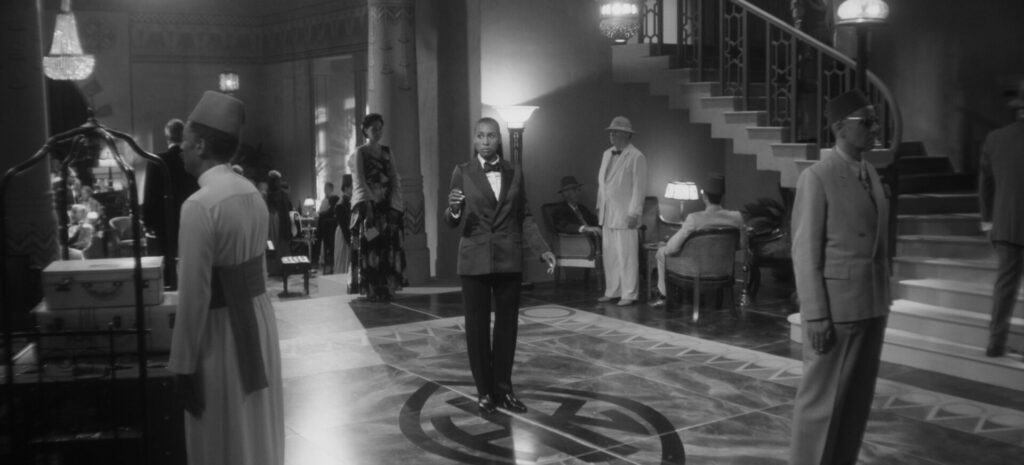
Q: Let’s dig into that moment when Brandy first arrives in Hotel Reverie and the world starts building around her. How did you approach the VFX for that shot?
Pete, VFX Supervisor: This was a really great scene to work on and I’m really proud of the result. Charlie Brooker (Creator) and James Mac (Overall VFX Supervisor) had a pretty good idea of what they were looking for in this shot. It had to have a feeling of analog in a digital simulation, almost how a photograph develops in a traditional chemical process. We did lots of look dev for this scene to help us narrow down the creative. We had planned to use Maya/Houdini for the development of the scene, but due to timings, we had to rethink how we approached this shot. I needed to have the control of the whole scene and the ability to make quick changes to the timings without having to keep going back through a CG pipeline, so I made the decision to do it in Autodesk Flame. We had a highly detailed lidar scan of the set, so this formed the backbone of the setup. I got our 3D team to prep and line up the scan and export it ready for use in Flame. From there I created all the different states of the simulation, going from wireframe through to a fully rendered finish. The wireframe pass was created using Flame’s geo rendering option wireframe. I have always loved using 3D geometry in Flame, so this was a moment to finally get to use them in a project and they look great. From there I created a series of animated mattes that were then projected onto the geo to reveal each element to create the final result.
Q: How does Flame support the kind of work you do?
Evren, Head of Film & TV: The short answer is we’ve always used Flame. When we started moving into film and TV, one thing that really helped set us apart and helped build our client base was the speed at which we could work. Coming from a commercial background, we were used to moving fast. We started with maybe three or four shots on Episode 3 of The End of the F**ing World and by the end we were doing 20 to 30 shots per episode. From there it just snowballed and 5 years later we are talking to you about working on Black Mirror! Flame gave us the ability to move quickly, work interactively, and make changes in real time, especially when we were in the room with clients. That speed comes from our commercial roots. Back then, you were in suites charging thousands of pounds an hour so time was critical. You had to be fast, efficient, and sharp. That mentality and talent are still here, even if the rates aren’t what they used to be. So, for us, Flame fits that workflow perfectly.
Pete, VFX Supervisor: Flame is always my tool of choice. In my opinion nothing comes close, it’s just so interactive. Having a fine art background, it really gives me the ability to get my ideas out onto the screen quickly. I can work as quick as I think which is really important. Trying to visually articulate what a client wants can be a hard, Flame gives me the confidence to deliver. There is a reason why after so many years it’s still the go to tool for so many amazing artists.
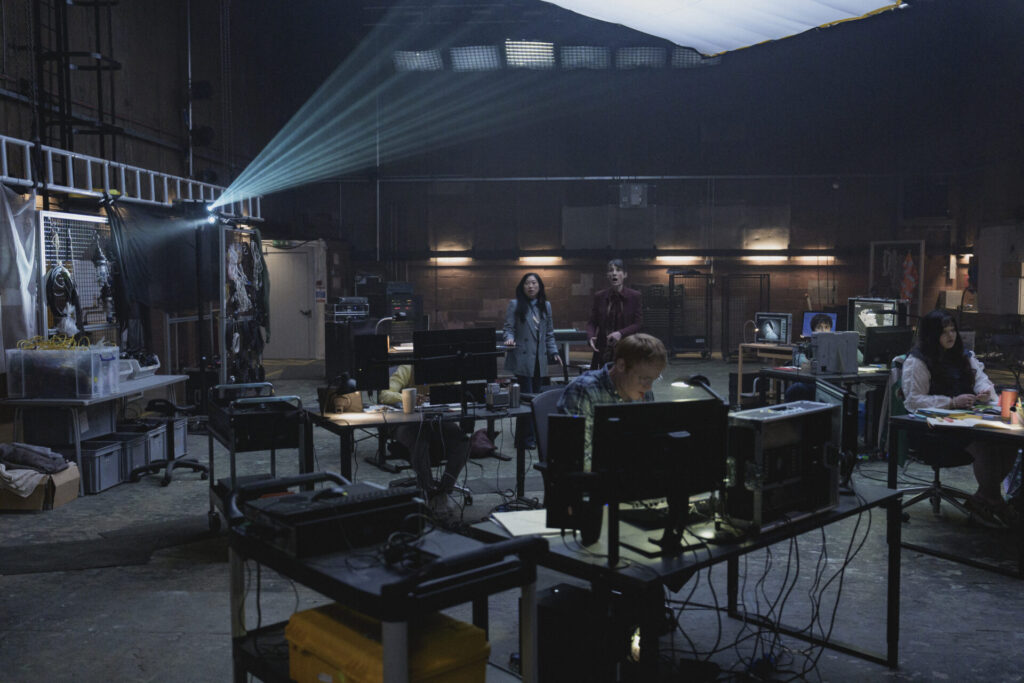
Q: What other tools helped you tackle intricate sequences?
Evren, Head of Film & TV: There were a couple of key sequences where Autodesk Maya really made the difference. The first was the “entering the void” sequence. That shot was built around the idea of a character walking into a digital wall or boundary. On set, they used a laser line to give us a clean edge where the wall should be. But like a lot of things in VFX, the camera angles and framing didn’t needed a little finessing when we got into post. To create the sense that the real Clara was passing though a digital wall we reprojected the wall onto the environment, rescaled it, repositioned it, and then rotomated her body in Maya. Once that was in place, we could properly adjust the wall’s shape to wrap around her hand and fingers in a way that made it feel three dimensional. It was subtle, but it made a big difference.
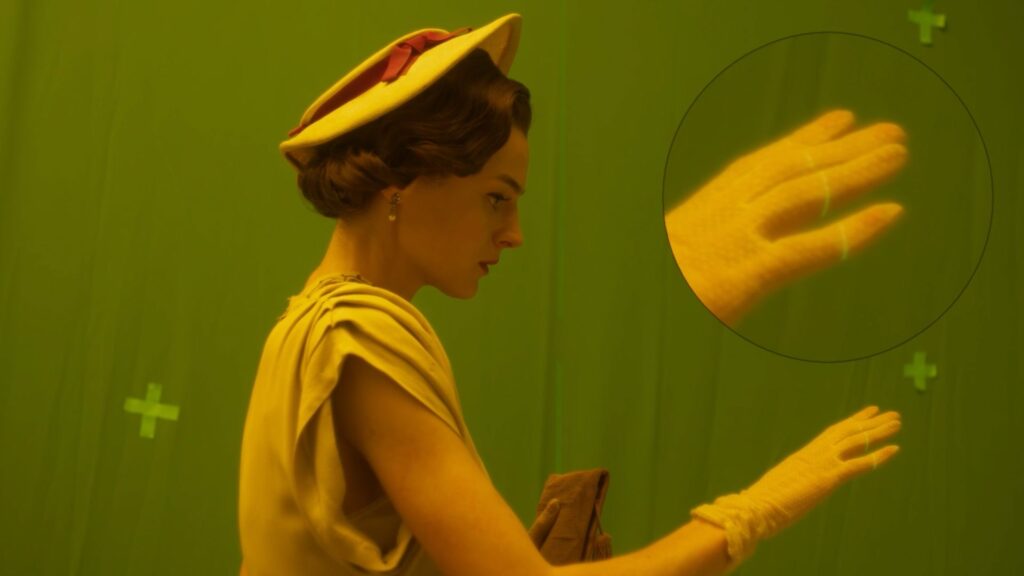

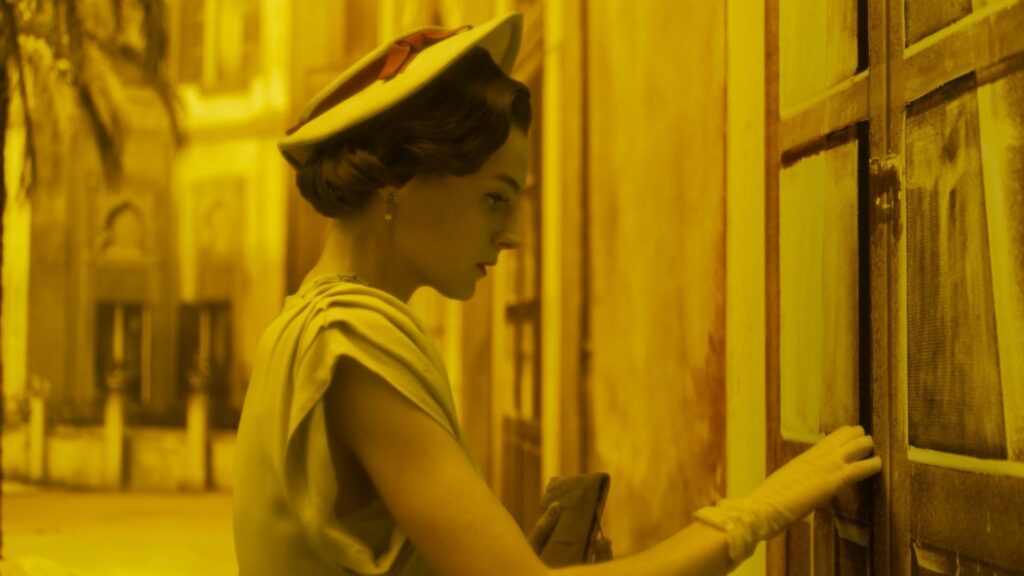
Pete, VFX Supervisor: Yeah, and that rotomation was important for more than just geometry. One early decision was that when she touches the wall, there wouldn’t be any shadow because it’s a simulation. But when we comped it without shadows, it just looked wrong. It felt like a bad comp. You didn’t believe she was touching the wall. So, Nick, our CG artist, used Maya to rotomate her body, and that gave us true shadow interaction, accurate to the scene’s lighting. That single addition really sold the shot. Even if it technically contradicted the “simulation” idea, the comp needed it to feel believable.
Evren, Head of Film & TV: The second major scene was the rooftop. Again, we built the background buildings in Maya. There was a practical scenic that gave us a bit of depth and the brief was to populate the mid ground and over the edge of the building with a full street scene below it. That led to a lot of discussion about what a Noir-era street scene should look like. In the past they would have used miniatures. So, we built the city in Maya, keeping that miniatures-style scale in mind. That’s not something we could have pulled off with just 2D matte paintings. The CG setup gave us the flexibility to scale, reposition, and light everything to feel right for the period and the shot. We also used subtle simulated lighting to give a stronger sense of depth and height, so the scene felt truly high up, perched on a dangerous rooftop. All of that added a lot, even if it’s not something the audience consciously notices.


Q: Do you have any “bet-you-didn’t-know-this” facts for me from working on the show?
Evren, Head of Film & TV: Black Mirror is probably one of the richest shows out there in terms of hidden details, things that are concealed or a bit Easter egg-y. Other shows don’t necessarily go that far. In Bête Noire, the episode is about a woman who creates a device that can manipulate reality, but really, it’s a tool she uses to gaslight someone. Early in the episode, there’s a hat on a table in a restaurant called either Barney’s or Bernie’s. Depending on which of the two episodes you land on you might see a different name. Some people saw Bernie’s, others saw Barney’s. It’s a tiny detail, but it’s there. It even blew up on social media when people noticed it.
Q: Your industry doesn’t do “same old”. How has your work changed in the last few years?
Evren, Head of Film & TV: In advertising, we worked in a very traditional way. We were grading, clients were in the suites with us all the time, giving feedback live. But over the years, that’s shifted to a much more film and TV–centric pipeline. We’ve had to change how we produce, how we manage shots, how we integrate teams. We moved away from other 3D tools into a Maya-based pipeline, all to respond to the type of work we’re now doing. Everything has shifted: the data we report on, how we prep projects, how we build pipelines. In film and TV, you might have four to six months to deliver 400 shots, but you’re not bringing in a massive volume of day-to-day work like in commercials. That means every shot has to be approached as efficiently as possible so you can still be creative without going over time. Even a small overage on each shot adds up quickly and can make profitability really difficult.
Pete, VFX Supervisor: From a Flame-specific perspective, I think it’s interesting how we’re always pushing to work faster and more efficiently. But every time we do, the technology moves too, resolutions go up, bit depths increase, file sizes balloon. So, there’s this constant push and pull: just as you’re getting faster, suddenly you’re working with 6K plates and 32-bit motion vectors, and your machine’s chugging again. You’re always trying to stay ahead, making sure your system is specced properly to keep up with these demands.
Q: Last question. What would you say is No.8’s superpower?
Evren, Head of Film & TV: That’s a good question. I’ve only been here a few months, but from what I’ve seen, it feels like we’re constantly punching above our weight. What really stands out to me is the depth of experience across the team. Collectively JAMs senior team have known Jim and Barney, the original founders of No.8, for years. Jim’s an incredible Flame artist, and Barney, as CEO, is just a fantastic EP and a great leader. There’s a real grounding here in both craft and people. The company’s motto is better together, and I think that captures the essence of what makes No.8 special. That collaborative DNA is still very much part of the culture. The idea is that by bringing together different disciplines and people who’ve worked together for a long time, the sum becomes greater than the parts. We know how to pull together the right people, from different backgrounds, to build something that feels bigger than we are individually.
Get to know No.8: https://no8london.com/
Create without limits with Autodesk solutions for visual effects: https://www.autodesk.com/campaigns/media-entertainment
Watch Black Mirror S7 streaming now on Netflix.