 Autodesk Media & Entertainment
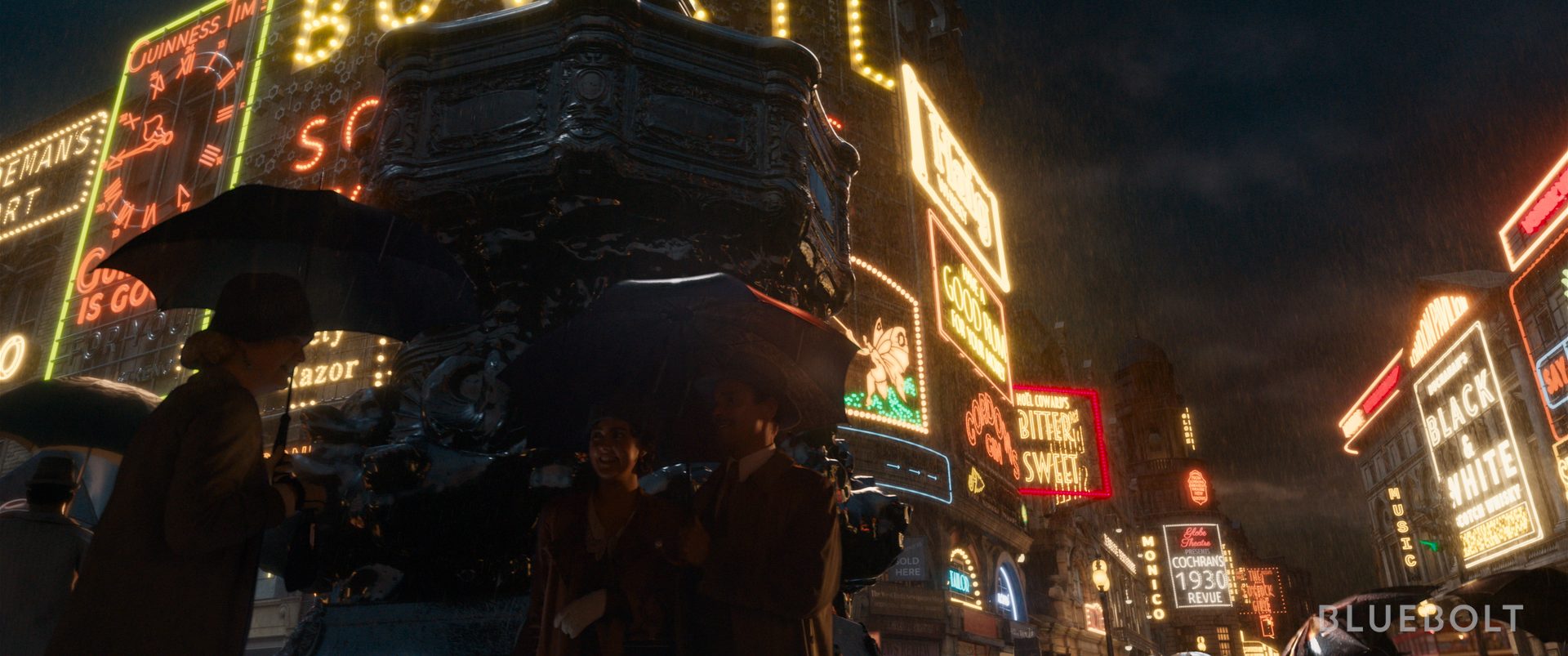
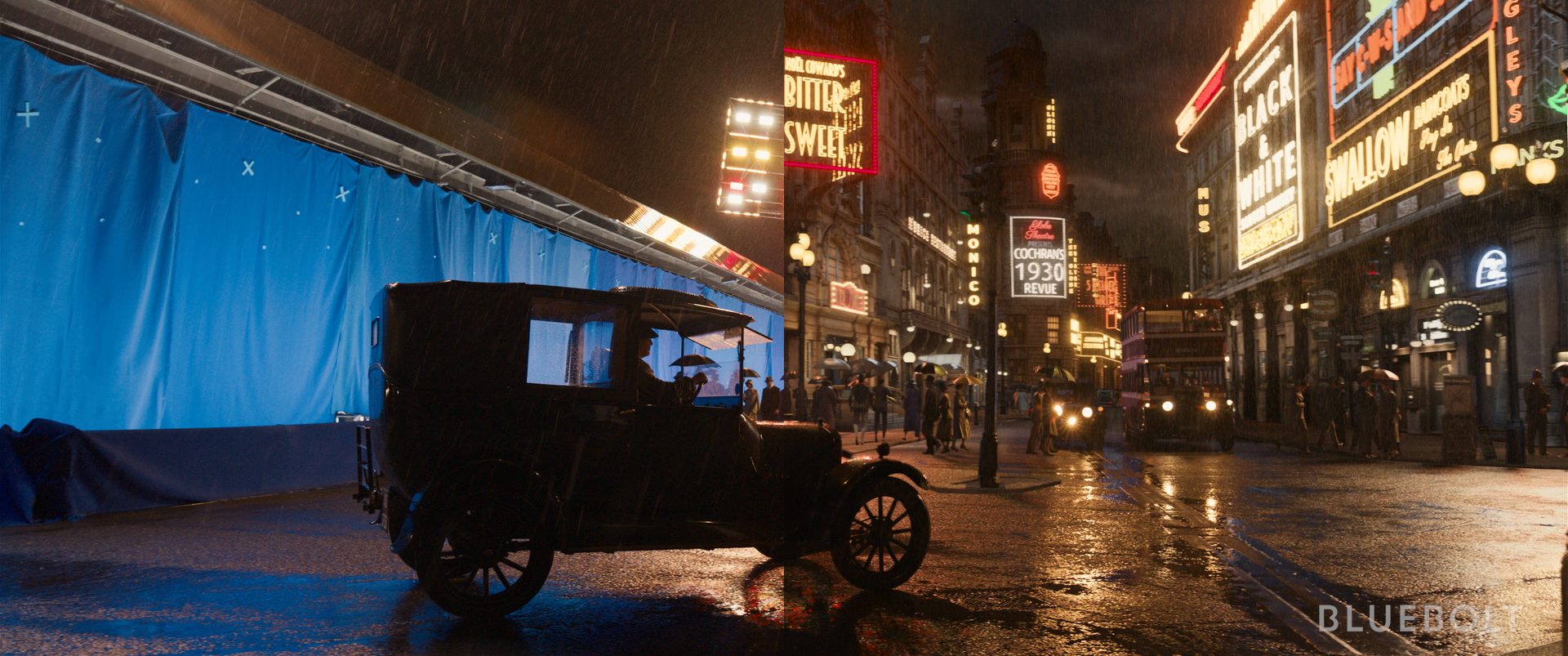
If you saw Downton Abbey: The Grand Finale, you likely remember the opening moments: a majestic shot that starts by panning down the Shaftesbury Memorial Fountain, moves through 1930s Piccadilly Circus — electric with traffic, glowing with billboards, alive with crowds — before gliding into the Richmond Theatre, where a performance of Noël Coward’s operetta Bitter Sweet is underway. It’s a single, elegant movement that establishes the film’s tone, era, and ambition all at once. It also sets the emotional stage for the Crawley family’s final chapter.
What most viewers don’t realize is that this seemingly effortless shot is anything but simple. It is a carefully choreographed blend of live action, historical reconstruction, digital crowds, vehicles, lighting, and fully CG environments.
Digitally recreating 1930s London
That opening sequence was created by BlueBolt VFX, an award-winning visual effects studio based in London. Known for its meticulous work on high-end film and television, the studio has delivered VFX across a wide range of productions, including Peaky Blinders, The Last Kingdom, The Great, The Northman, Napoleon, and Nosferatu.
For Downton Abbey: The Grand Finale, BlueBolt delivered 138 visual effects shots, helping to recreate and capture the vibrant, pre-war England of the 1930s. The centerpiece was arguably Piccadilly Circus — rebuilt digitally and integrated into a continuous shot that stitches together two different filming locations for one cinematic moment.
“As a Londoner who has lived and worked in the heart of the West End for longer than I care to admit, it was very exciting,” says Dave Cook, CG Supervisor at BlueBolt. “Not only to faithfully recreate Piccadilly Circus of 1930, but to evoke the atmosphere and allure of the West End in the opening shot of a well-loved show with such high production values.”
Blending locations into one continuous sequence
According to Henry Badgett, VFX Supervisor at BlueBolt, the production timeline spanned almost exactly a year, from early discussions in March 2024 through final delivery in March 2025. Roughly 20 2D artists and 10 3D artists worked on the project, with Cook and Badgett supported by second supervisor Graham Day and VFX producer Theo Burley.
A detailed technical visualization (tech-viz) phase allowed the team to anticipate how the shot would be captured across multiple locations. A rough camera pass filmed directly in Piccadilly Circus provided invaluable real-world reference, while historical maps helped the team construct an accurate digital model of the area as it would have appeared in the 1930s.
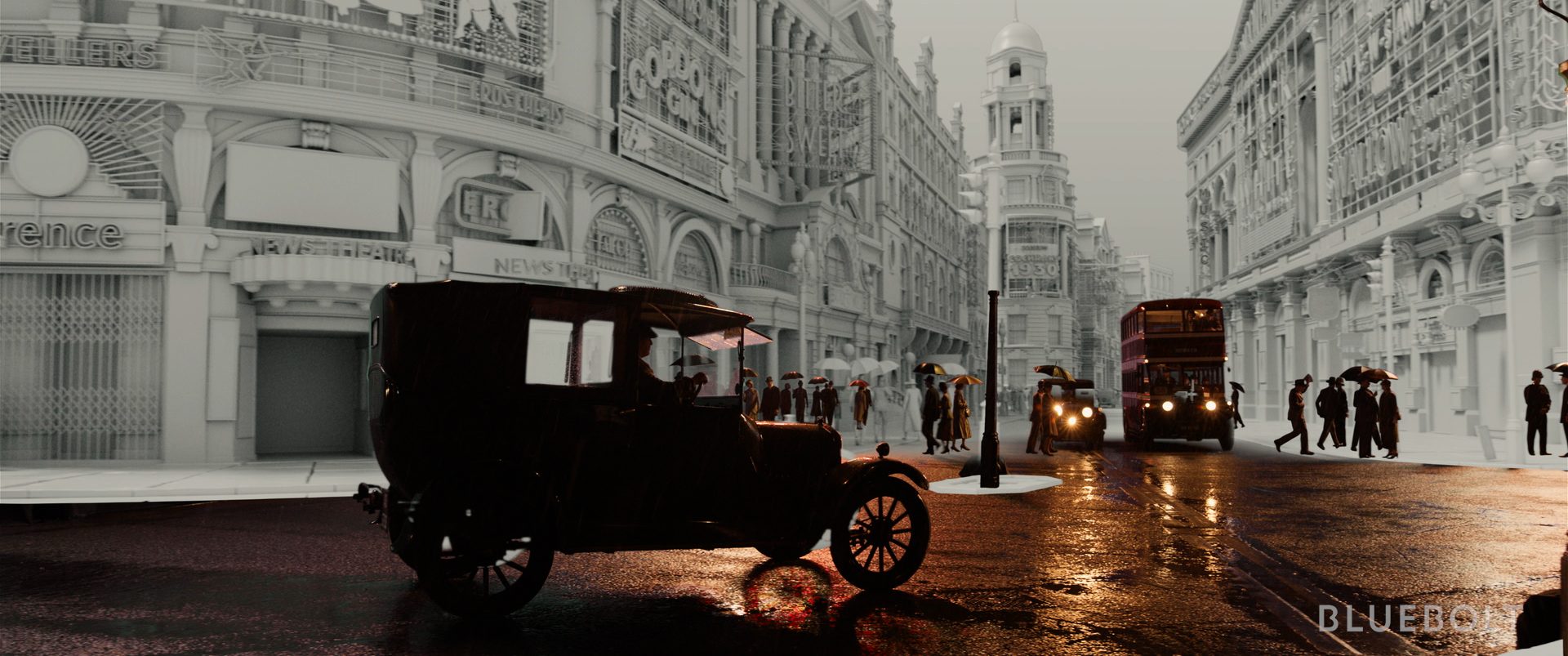
That accuracy, however, needed to meet the vision of director Simon Curtis and DP Ben Smithard. The real Piccadilly Circus and the blue-screen shoot at Mortlake Studios differed in size and layout, requiring careful adjustments to scale, framing, and timing.
Meanwhile, BlueBolt’s artists began building detailed assets for the iconic buildings along Shaftesbury Avenue and assembling an extensive reference library for period-correct advertisements and billboards.
Bringing it all together
When the live-action plates arrived, the real work began. Each plate was camera-tracked and brought into the tech-viz layout, where multiple camera moves were blended into a single, continuous motion. Retiming and repositioning were necessary to ensure the transition felt fluid rather than stitched together.
Lighting became one of the sequence’s quiet heroes. The team recreated period-accurate street elements — roads, pavements, underground entrances, and lighting fixtures — then lit the CG environment using high-dynamic-range imagery (HDRI) captured on set. These base lighting passes were layered with animated billboard lights, vehicle headlights, and reflections, all carefully synchronized to the camera move.
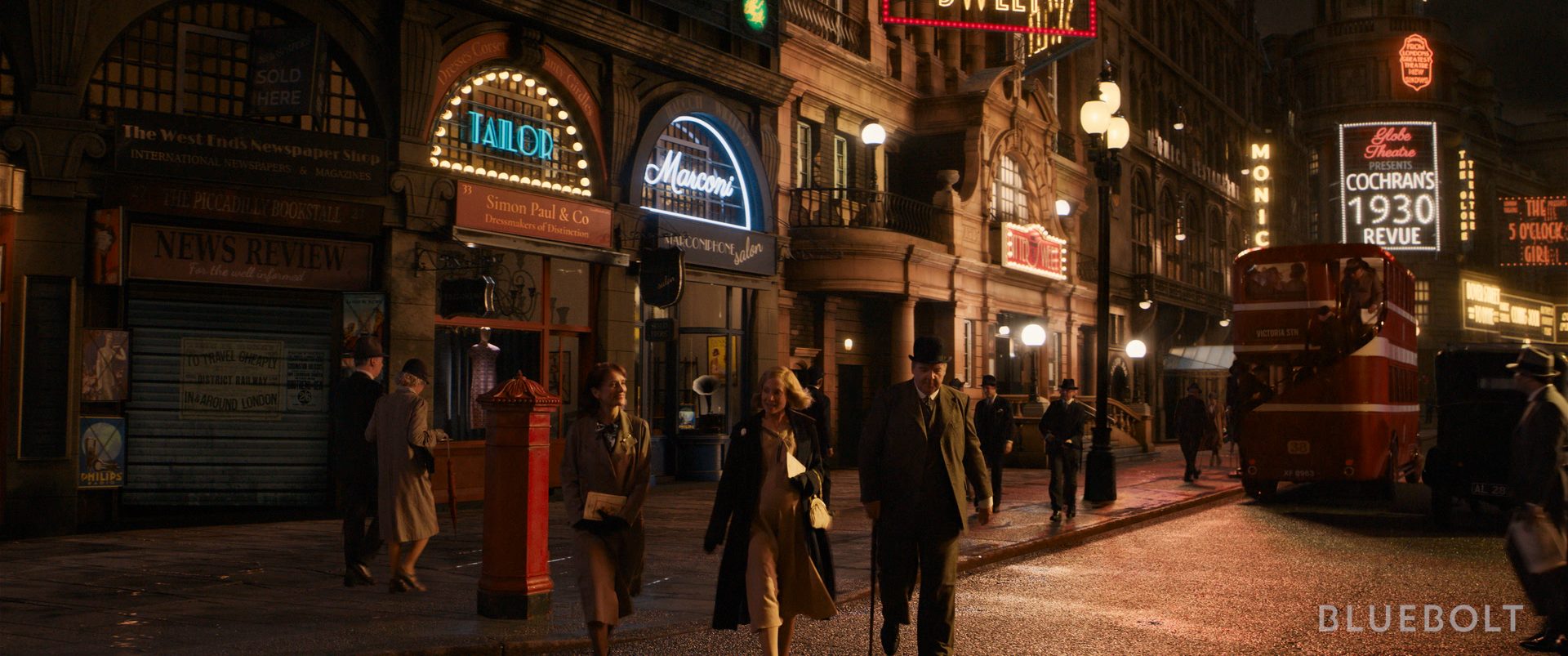
“Different techniques were employed for the different lights — mesh lights, instanced lights in animated sequence, and emissive geometry,” Cook says. “Timing of all of these light animations needed to be synchronized to the composition.” A subtle layer of London fog — lighter than the real thing, but historically evocative — softened the scene, allowing lights to bloom gently and giving the environment depth and atmosphere.
Crowds added another layer of complexity. Digital extras had to match the practical performers not only in placement, but in wardrobe and movement. Raincoats, evening dresses, and umbrellas required cloth simulation to behave naturally, especially in the wet conditions.
“The Piccadilly shot had many processes in one extremely long shot, which made it effectively more like a sequence in terms of complexity,” says Cook. “There were a lot of elements to integrate.” And like a sequence, dozens of systems had to work together without drawing attention to themselves.
Embracing production constraints
As carefully planned as the sequence was, the realities of production still intervened. The blue-screen shoot offered only a four-hour window between sunset and wrap — and it poured with rain the entire time.
Rather than fight it, the team embraced the weather. “We thought of it as a free wet-down, which we would have done anyway for the reflections of the Piccadilly lights stand-ins,” Badgett says.
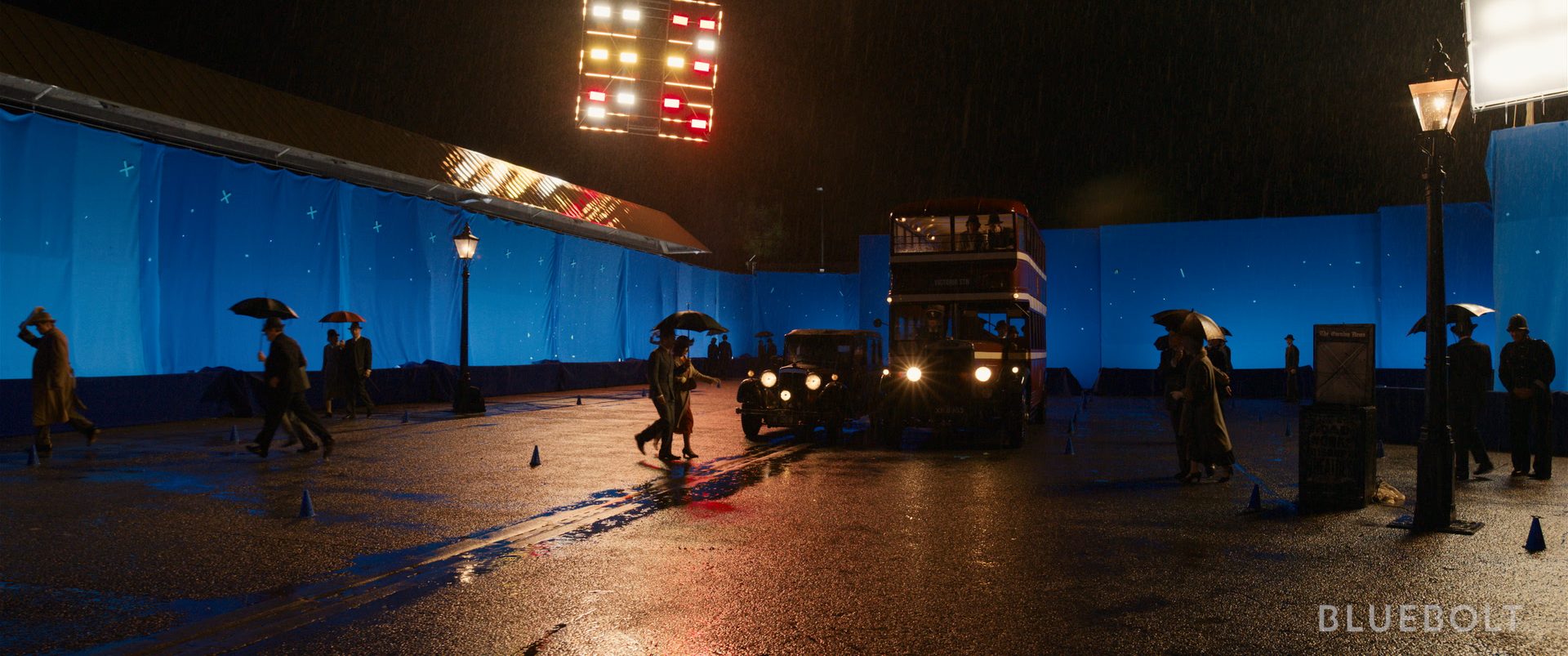
Another challenge emerged in the edit: Piccadilly Circus still felt too quiet. The handful of vintage vehicles captured on set weren’t enough to sell the scale and energy of the location. BlueBolt ultimately added dozens of CG cars and buses — complete with drivers and passengers — threaded carefully between live-action elements. “There were quite a few near misses!” Cook says.
Beyond Piccadilly
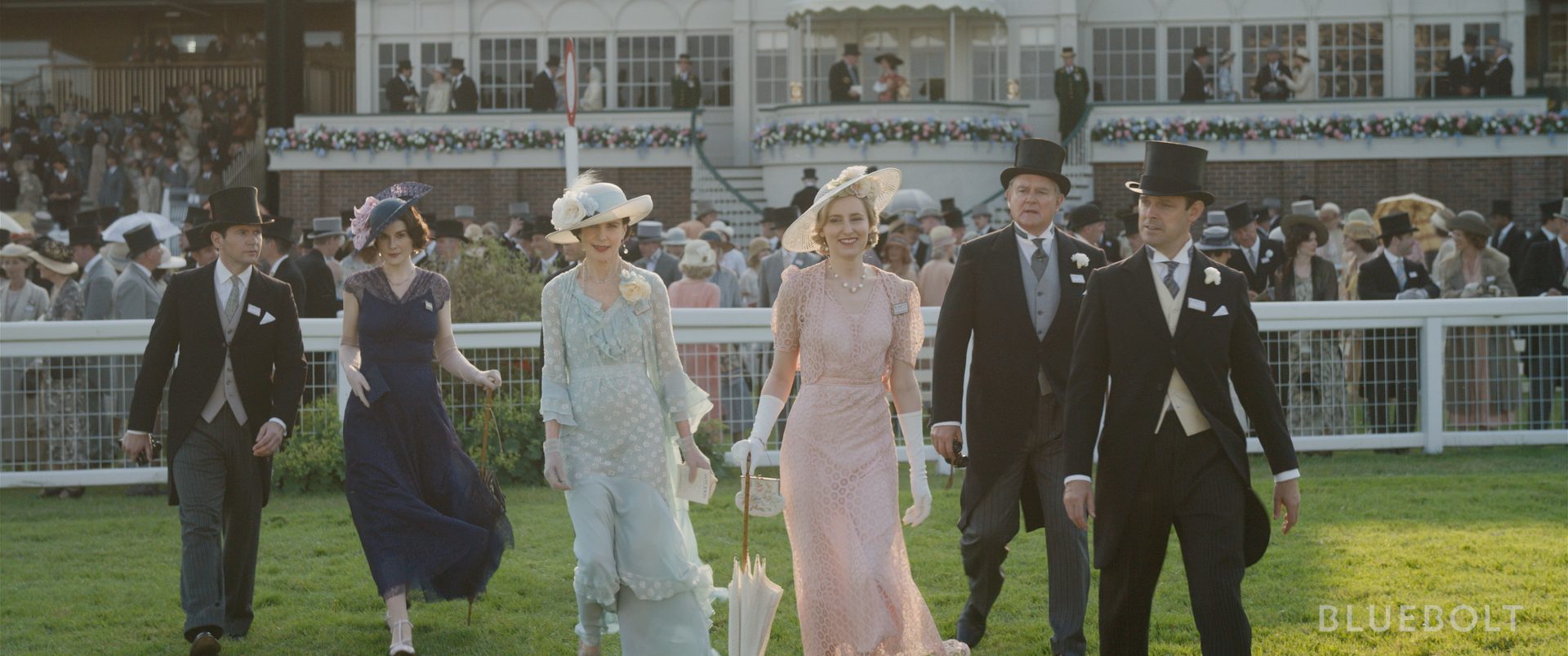
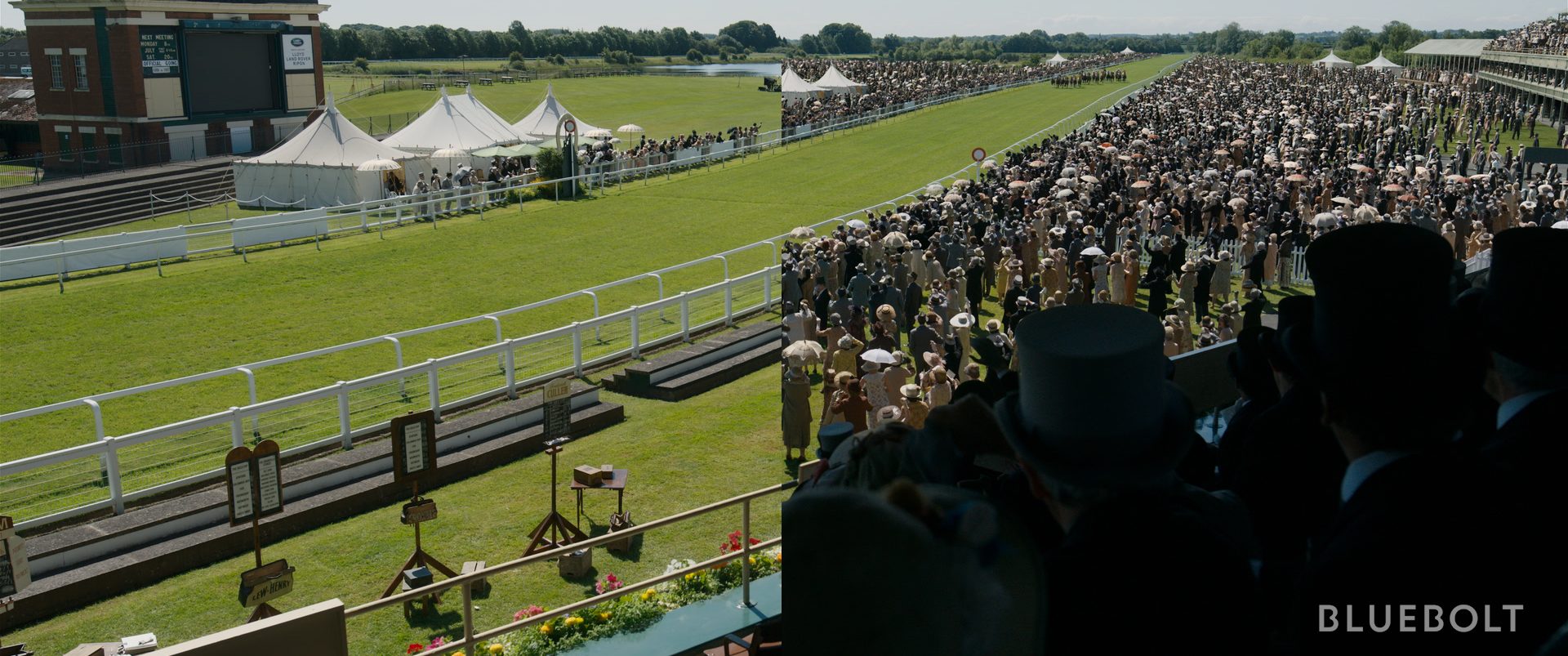
The Piccadilly Circus sequence was an important showpiece in the film, but not BlueBolt’s only challenge. The studio also contributed to scenes depicting Royal Ascot race day, recreating grandstands and extending crowds filmed at Ripon Racecourse.
In addition to modifying the racetrack buildings, thousands of digital spectators were added to the stands and paddocks, with careful attention paid to movement, density, and variation. Even small details — like the inclusion of parasols — helped the crowds feel alive.
Building a flexible VFX pipeline with Maya, Arnold, and Golaem
While BlueBolt’s artistry drives the work, its technical foundation plays a crucial supporting role. The studio relies heavily on Autodesk Maya, using it from early pre-vis through final delivery. “Maya is an open, extensible framework well suited to take a shot from the earliest previs to the final delivery” says Cook. Arnold was used for everything on this film, and allowed the team to work within a physically based rendering (PBR) pipeline while retaining flexibility for shot-specific adjustments — critical when dealing with long takes and heavy asset counts.
For crowds, BlueBolt uses Autodesk Golaem, a crowd animation and simulation plug-in for Maya. “Golaem is very flexible in constructing mixed crowds with a range of behaviours that we can transplant from our standard rig and library across different shows,” Cook says. “It’s also useful for things like adjusting individual joint angles, to give variation on things like the angle of raised umbrellas which otherwise might look a little repetitive.”
Just as important are pipeline efficiencies. Stand-in-based rendering and lightweight scene management allow artists to work interactively, even on asset-dense shots, without technical friction. “With Golaem caches, the render scenes can be very light, even with large crowds. With render set up layers, light groups and light path expressions, there is enough granularity to isolate any lighting or shading detail.” Cook says.
Raising the bar for invisible effects
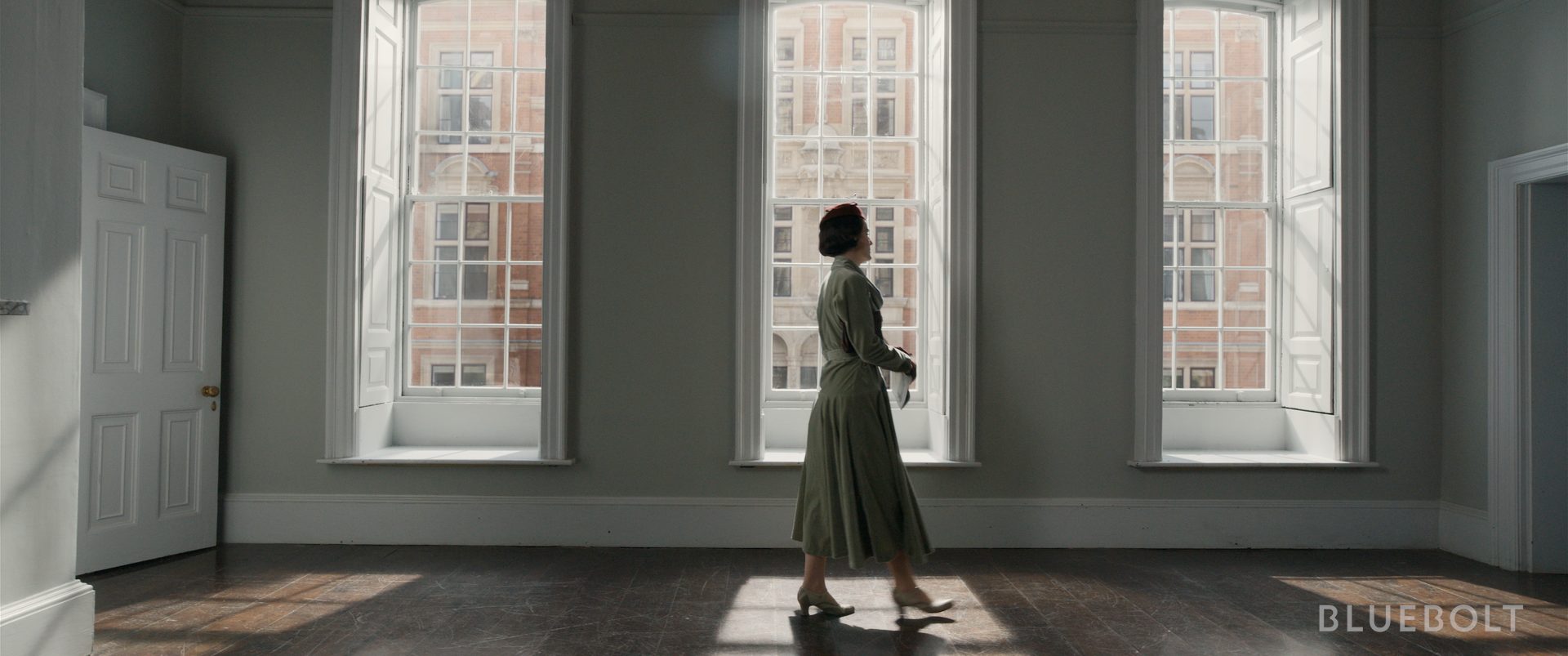
Downton Abbey: The Grand Finale marks the cinematic conclusion to a 14-year cultural phenomenon beloved by fans around the world. But for BlueBolt, it’s another step in an ongoing evolution.
The studio continues to expand its slate, with recent and upcoming projects including Wuthering Heights, season two of A Thousand Blows, Amadeus, and Young Sherlock. Along the way, the team keeps refining its approach to the growing demand for invisible VFX. “VFX artists are producing ever more believable work and then hearing interviews claiming the shots were all in-camera,” Cook observes.
That invisibility raises the bar. “This emphasis on invisible VFX work demands a very close alignment to a director’s artistic vision and understanding of the editorial demands of a shot to work properly,” Cook says. In Piccadilly Circus, in Royal Ascot, and in countless other frames and sequences, BlueBolt proves that sometimes the most powerful visual effects are the ones you barely notice at all.
From lifelike 3D characters to extraordinary worlds, explore your most intricate ideas with advanced 3D modeling and animation tools.