 Cesar Escalante
Forma Site Design, available in the AEC Collection or as a standalone subscription, offers powerful AI-powered tools for architects and designers in pre-design and schematic design phases.
In 2025, Forma Site Design introduced targeted improvements across modeling, analysis, interoperability, and collaboration. Development focused on strengthening and stabilizing existing workflows, with emphasis on reliability, user control, and continuity between early site studies and downstream design tools.
The features below are the ones I consistently relied on this year because they directly reduced friction in real design decisions and made early studies more consistently connected to detailed design workflows.
Site Automation: Controlled Iteration Over Automated Outputs
Site Automation, formerly called ‘Explore’, started as a fast, automated way for you to iterate on building layouts to explore massing potential and site capacity, based on predefined layout rules and typologies. In 2025, Site automation evolved into a more interactive tool that provides greater control over design output.
I can switch between multiple layout alternatives, adjust edges and vertices, or draw custom lines to reshape the layout, while simultaneously modifying building typologies, heights, widths, and floor counts within a selected proposal, accelerating early massing exploration through automated generation paired with greater design control.
Environmental Analysis: Sun, Wind, and Microclimate Maturity
A must for site analysis: taken together, these improvements allow you to use environmental analysis earlier and more frequently, treating it as a comparative design input rather than a validation step late in the process.
Environmental analysis capabilities advanced meaningfully in 2025 across sun exposure, wind behavior, and microclimate assessment, with updates focused on making results easier to interpret, compare, and act on during early design.
New analysis highlights expose configurable KPI summaries in the side panel, while next-generation microclimate analysis improves clarity through updated visualizations, median weather data, and more responsive interactions. Additional enhancements, including independent outdoor area analysis, improved selection controls, and microclimate results on roofs.
Revit Interoperability: Coordinates Flexibility
Particularly important to my workflows, interoperability between Forma and Revit saw targeted improvements, particularly around geolocation. Previously, transfers could overwrite existing coordinate systems, leading to downstream coordination issues.
With the plugin release 9.18, you now retain control over how coordinates are handled during transfer, preventing unintended overrides. Additional refinements, including improved road attribution, increase consistency between site models and BIM environments.
Embodied Carbon: From Beta to Operational Use
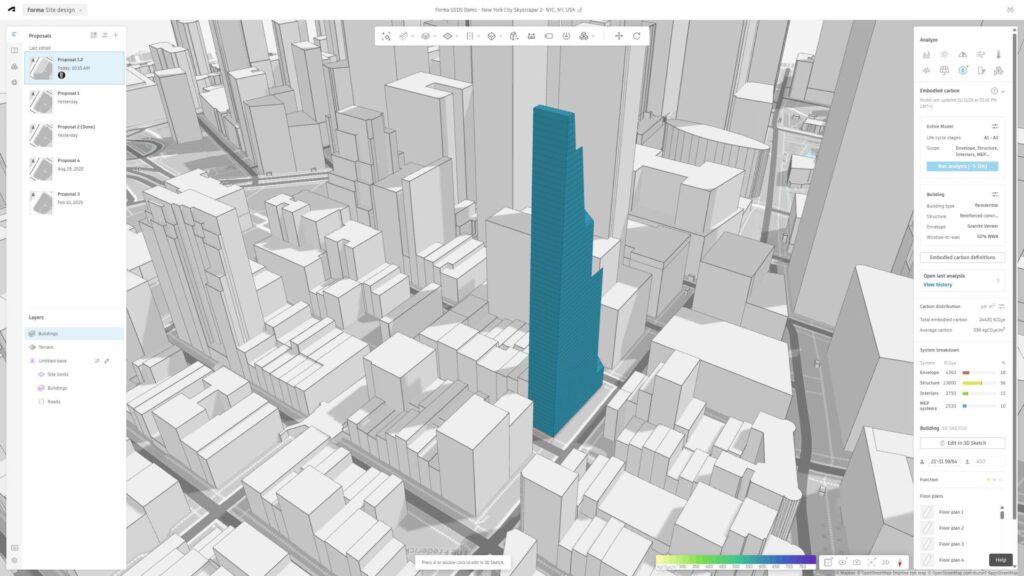
An early-phase carbon calculator: Embodied carbon analysis reached operational maturity in 2025. The most significant changes occurred behind the interface, including stabilization of datasets, calculation models, and update handling.
You are now notified when backend data or methodologies change, reducing ambiguity in results. Additional guidance clarifies definitions and assumptions, helping you interpret metrics consistently.
As a result, you can treat embodied carbon analysis as a dependable early-stage input rather than an experimental signal.
Terrain Controls: Pads
In 2025, the Forma team took the first step toward dedicated topography tools by making terrain editing available directly in the design toolbar, replacing the previous terrain tooling that was accessed through the Layers menu.
Now you can draw terrain pads freehand along visible contour lines, adjust elevation interactively or numerically, and define pad slopes using ratios or percentages. Real-time metrics expose pad volume and the total site mass balance, enabling you to assess cut-and-fill impacts as the geometry evolves.
These updates lay the groundwork for future topography editing capabilities.
Bonus: Boards and Docs: Consolidated Collaboration Workflow
Forma Board matured through tighter integration with Docs and expanded widget functionality. You can now create boards directly from project data management, reducing friction between documentation and collaboration.
When you add sheets to a board, they function as rich Docs widgets rather than static images. This allows you to reopen source files, add content, and maintain live links to project data.
My Closing Perspective and 2026 Outlook
In 2025, Forma Site Design concentrated on improving and reinforcing core workflows and improved continuity between early site studies and downstream design environments.
And announcements at AU 2026 hint at what’s to come. In 2026, we can expect Forma to move further from point capabilities toward an integrated platform, providing deeper, more persistent connectivity between Forma and Revit. Building definition workflows are expected to extend beyond massing toward more structured conceptual representation, and expanded AI capabilities supporting comparison, iteration, and decision making.