 Autodesk Media & Entertainment
Visionary director Guillermo del Toro had been dreaming about making his own adaptation of Mary Shelley’s Frankenstein for more than three decades. Best known for projects like the 2006 film Pan’s Labyrinth and The Shape of Water in 2017, Frankenstein was, he said as early as 2007, a film he “would kill to make.”
The film launched on Netflix on November 7th, and was widely recognized as a visual and artistic triumph—earning multiple Academy Award nominations, including Best Picture. Every element of the Netflix film contributes to its haunting atmosphere: in addition to a great script and incredible performances, the production design, cinematography, costumes, and score all combine to create a world that feels both mythic and tangible.
Behind the scenes, visual effects played a crucial role in shaping that world. To realize his vision, del Toro collaborated once again with the artists at Mr. X, the Toronto-based VFX studio known for its work on other del Toro projects such as The Shape of Water, Crimson Peak, and Nightmare Alley. Over the course of nearly two years—from November 2023 through September 2025—the Mr. X team delivered 950 shots for the film.
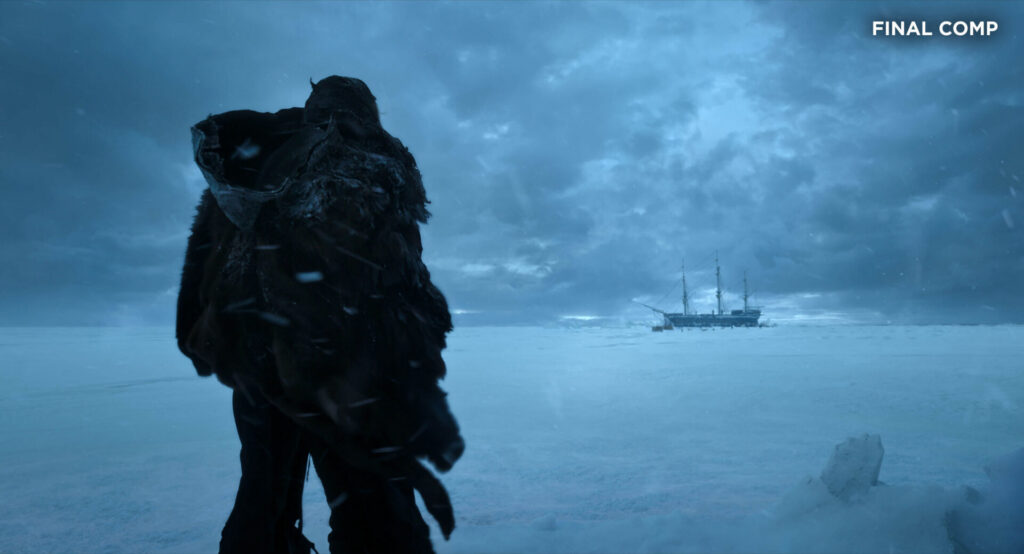
Some of those shots were overt visual effects sequences. Others were subtle enhancements—environment extensions, invisible fixes, and atmospheric details such as sky replacements that appear in almost every scene.
Behind the artistry was an enormous production effort. Coordinating thousands of assets, shots, and iterations across departments required a sophisticated workflow. At the center of that pipeline was Autodesk Maya for modeling and animation, and Autodesk Flow Production Tracking, which served as the production hub that kept the entire team aligned.
A studio built on collaboration
Founded in 2001 by VFX veteran Dennis Berardi, Mr. X quickly established itself as a studio that blends technical innovation with artistic craft. Over the years the company has contributed visual effects to major film and television projects while collaborating with some of the industry’s most celebrated filmmakers.
The studio has evolved through multiple phases, including a period within Technicolor’s global VFX network before Berardi reacquired the Mr. X name in 2025. Throughout those changes, the company’s focus has remained consistent: building teams capable of delivering complex visual storytelling at scale.
Joining the project early
Mr. X became involved in the film long before cameras started rolling. “We got involved during pre-production, which was really valuable,” says Ayo Burgess, VFX Supervisor at Mr. X. “It allowed Mr. X to help shape decisions with Guillermo del Toro, Dennis Berardi, Dan Laustsen, and Tamara Deverell.”
The team contributed to AR-based tech scouts, previs, and techvis, helping test ideas on location and plan complex sequences before production began. “Mr. X was involved from the outset, taking part in the earliest discussions about the project,” explains Brandon Schaafsma, Overall Associate VFX Supervisor. “In earnest our work began five months before going to camera.”
During this phase, the artists developed early story beats and asset concepts that would guide other departments. “At Mr. X, we were focused on developing key assets and story beats,” Schaafsma says. “We animated storyboards to time out sequences, which developed into previs to help convey Guillermo’s vision to other departments.”
The goal was to ensure that visual effects planning was integrated directly into production design and cinematography rather than added later.

Building a visual language with Guillermo del Toro
Del Toro is known for his meticulous visual storytelling, and Frankenstein was no exception. “Our preparation started with developing a shared visual language through reference,” Burgess explains.
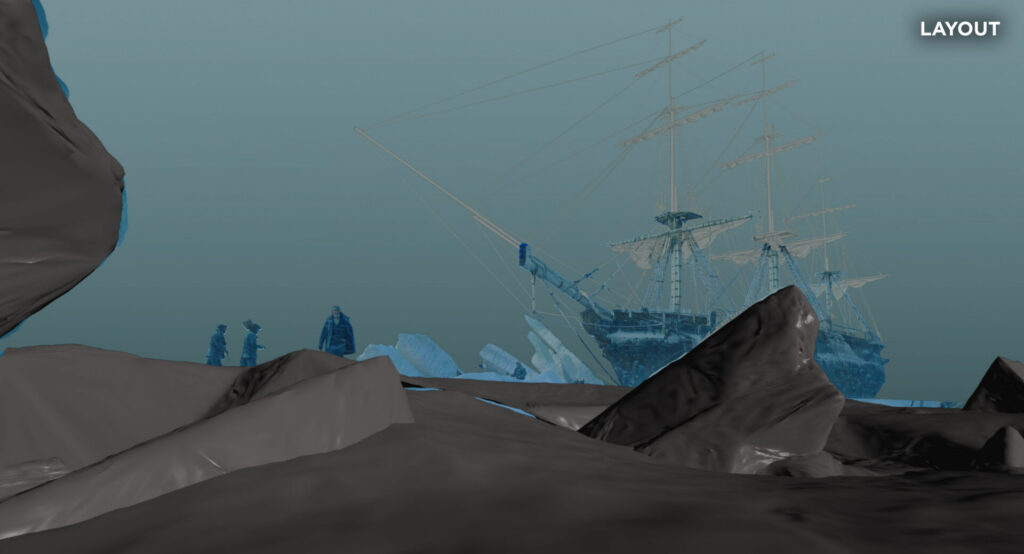
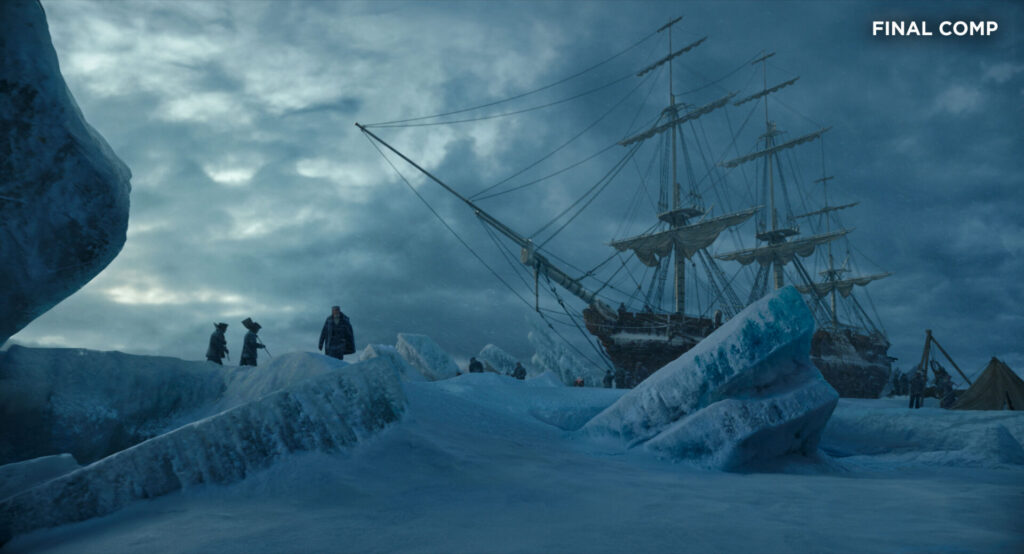
The creative team drew inspiration from a wide range of sources, including photographs from Ernest Shackleton’s Antarctic expeditions, landscape paintings by Albert Bierstadt and John Atkinson Grimshaw, and extensive location reference photography captured in Canada. These references informed everything from lighting and color palettes to environmental design.
The team also developed a new previs pipeline bridging Maya and Unreal Engine, improving the fidelity of early visualizations. “Having worked with Guillermo on several previous projects, we knew how integral previs was to his creative process,” Burgess says. “Many key elements established in previs carried through to final shots with very little change.”
Iteration at the speed of filmmaking
One defining characteristic of del Toro’s productions is the pace of creative iteration Burgess says.
“Del Toro was editing while he was shooting. As soon as he had a rough cut of a scene, he would turn over VFX.”
The Mr. X team responded with what they called “storytelling mockups.” These early versions weren’t intended to be final. Instead, they helped clarify the creative direction of a shot—replacing temporary backgrounds, extending sets, or removing production artifacts. “This workflow allowed us to give Guillermo creative flexibility without slowing momentum,” Burgess explains.
The result was a dynamic review cycle. “On Frankenstein, we often generated over a hundred versions a day and ran three to four internal dailies sessions,” Burgess says.
David Roby, CG Supervisor at Mr. X, notes that this process was typical of working with del Toro—but the clarity of the director’s vision made it unusually productive. “The process with Guillermo is always an iterative one, where we continually explore and improve the shots,” says Roby. “The difference with Frankenstein was that his vision had been honed for over twenty years.”
Practical effects meet digital artistry
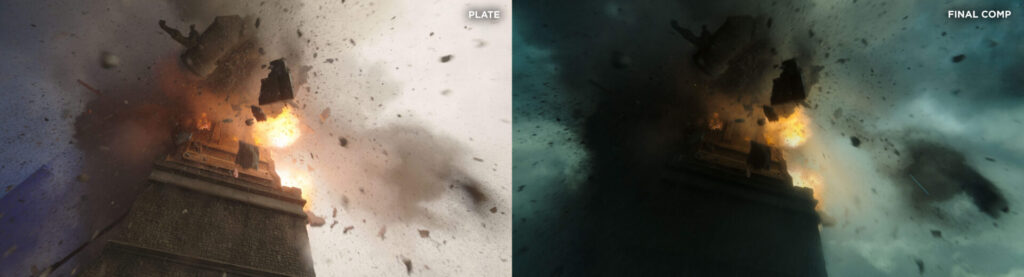
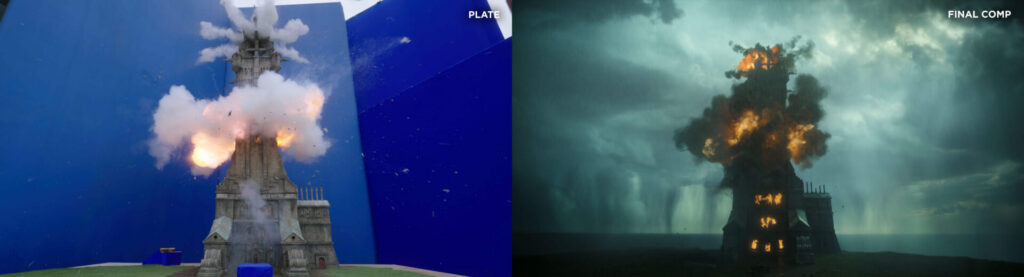
A defining characteristic of the film is its blend of practical effects, miniatures, and CG. For the destruction of Frankenstein’s laboratory tower, the production worked with José Granell’s team at Magic Camera Company to build highly detailed miniatures. “We provided them with our previs 3D tower model,” Burgess explains. “From there they built highly detailed exterior and interior miniatures at 1:20 and 1:4 scale.”
Those miniatures gave cinematographer Dan Laustsen the ability to shoot the destruction sequences with realistic lighting and camera movement. “Starting with plates where the creative intent is already signed off gives us a significant head start,” Burgess says.
The VFX team then layered additional work on top of those plates. “For the interior lab destruction, we worked directly over the miniature photography,” Burgess explains. “For the exterior destruction, we went full CG but continued to match the composition and lighting established by the miniature plates.”
Roby emphasizes how valuable practical elements can be—even when a shot ultimately becomes fully digital. “Having strong practical effects and miniatures ground the CG elements,” he says. “Even in instances where we had to do a full-CG takeover, the photographed elements are always invaluable for reference.”
Creating creatures: “The Lecture Corpse” and “The Flayed Man”
Two of the film’s most memorable moments involve unsettling anatomical experiments.
In “The Lecture Corpse” scene, Dr. Frankenstein demonstrates his research before a tribunal by animating a stitched torso.
The sequence was filmed using a practical puppet controlled by a puppeteer. “We kept the puppeteer’s fingers to preserve the tactile interaction with the ball,” Burgess says, “but replaced the rest of the arm up to the shoulder with CG.”
The team created a full digital model from scans of the puppet and animated it in Maya. “They shot a really evocative puppet performance on set,” Roby explains. “With such great plates, our mandate was to make sure we were only improving what was already there.”
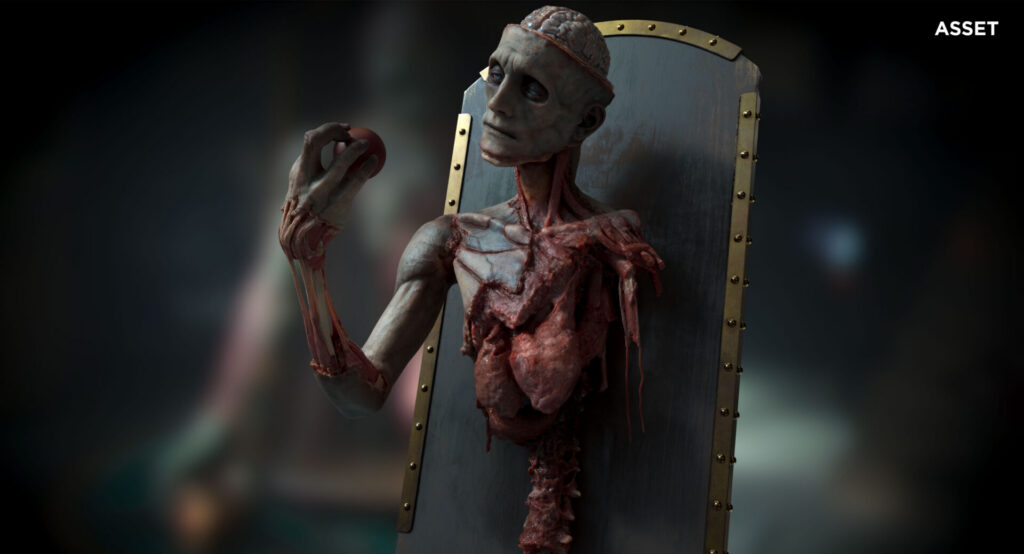
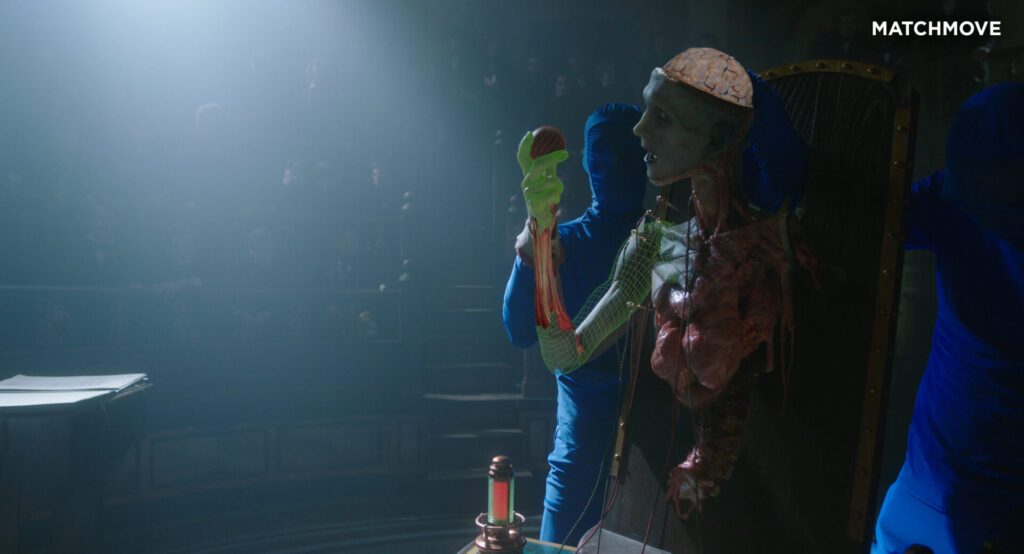
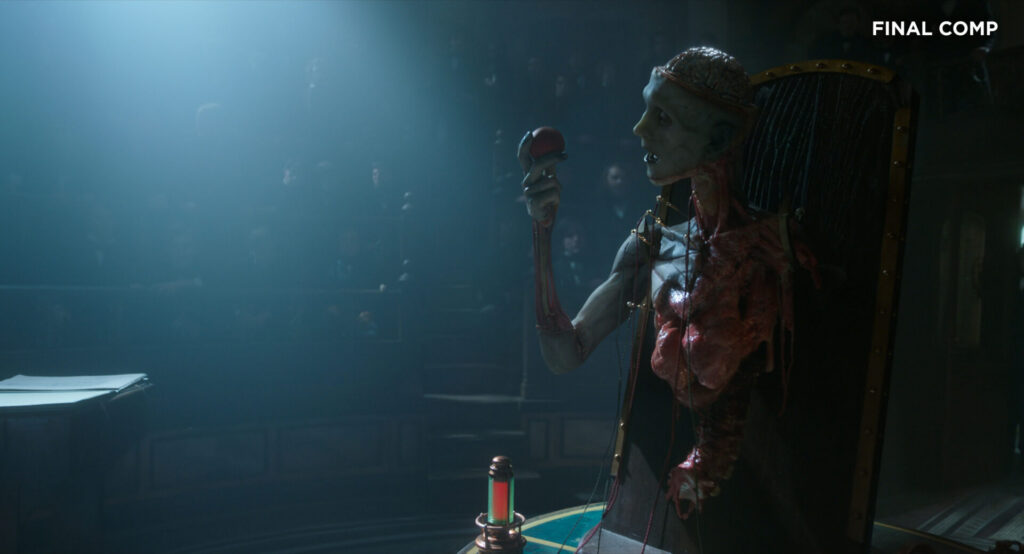
Another key sequence features what the crew nicknamed “The Flayed Man.” This partially skinned corpse briefly animates during one of Frankenstein’s early experiments.
“The Flayed Man had many challenges,” Roby says. “Particularly the sliding skin and tendons twitching on the back of the hand, as well as the complex muscle simulation.”
To fully integrate the performance, the team even replaced the surrounding set pieces digitally.
“We ended up replacing the entire foreground table in those shots,” Roby says, “so the performance would correctly interact with his surroundings.”
Building a world around Frankenstein’s tower
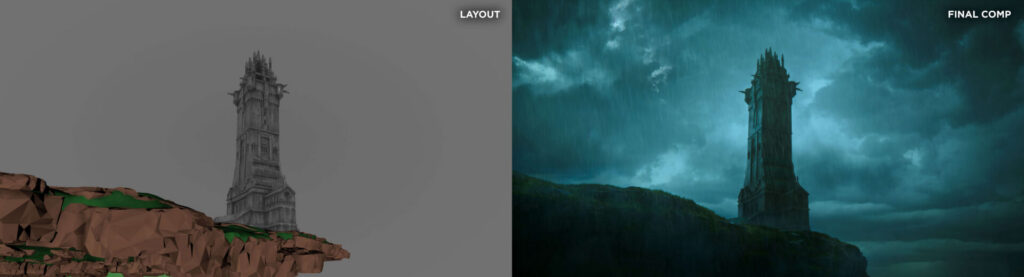
Environment work was another major undertaking. The landscapes surrounding Frankenstein’s tower were inspired by Seacliff in Scotland, but the final environment needed to support sweeping cinematic shots from multiple perspectives.
“The biggest challenge was scale,” Burgess says. The team built a single unified environment rather than separate versions for wide and close-up shots. The breakthrough came when they incorporated GIS data into the terrain layout. “Suddenly everything fell into place,” Burgess says. “Peak-to-peak distances made sense, and the environment began to closely match our reference photography.”
Roby adds that the environment had to integrate seamlessly with both sets and miniature elements. “We had the complexity of the 360-degree views around the lab tower,” he says.
“Laying out all the major components in Maya allowed us to build a strong, flexible backbone that informed the full build.”
Maya at the core of the 3D pipeline
Throughout production, Autodesk Maya was central to the studio’s 3D workflow. “Maya fit into the beginning of our 3D pipeline,” Burgess explains. “Camera tracks were ingested into Maya, and modeling, rigging, animation, and shot layout were all done there.”
Roby says Maya was also central to asset development and animation workflows. “Maya was the primary software for modeling, ranging from final render models to geometry used to generate procedural instancing workflows in Houdini,” he says.
The team maintained proxy versions of complex environments inside Maya so artists could work quickly while still maintaining compatibility with downstream tools. “All layout and animation was done in Maya and then exported to Unreal for temp and Houdini for final,” Roby says.
Organizing and coordinating with Flow Production Tracking
While Maya powered the creative side of the pipeline, Autodesk Flow Production Tracking served as the operational hub that kept the entire production organized.
“Flow Production Tracking was at the center of our production management,” Burgess says.
“We used Flow Production Tracking to track assets, shots, tasks, versions, milestones, and both internal and client notes.”
Across the project, the team tracked 1,755 shots and over 200 assets. “We track just about everything with Flow Production Tracking,” Burgess explains. “Sequences, shots, assets, publish events, review versions, review notes, tasks, delivery deadlines, editorial details, on-set data, color pipeline details, turnovers, and slates.”
Schaafsma describes it as the project’s primary operational tool. “In many ways it was the backbone of the project,” he says. “If it was data, or if it was viewable, we put it into Flow Production Tracking.”
The system also replaced traditional production tracking methods. “All incoming data from set went into existing or custom entities,” Schaafsma says. “This included onset measurements, lidar scans, photogrammetry, lens grids, HDRIs, editorial lineups, and reference photos.”
Because the system integrated directly with the studio’s digital content creation tools, artists could publish versions directly from their workstations. “Artists are able to publish from their DCC directly and populate the database with thousands of versions,” Schaafsma explains.
Connected workflows across the pipeline
For Caitlin Foster, VFX Producer at Mr. X, the biggest value of Flow Production Tracking was its ability to bridge the gap between creative teams and production management. “Any tool that you use as a producer needs to be an intuitive extension of your brain,” Foster says. “It should take as few clicks as possible to generate the information you need.”
She emphasizes that production management in VFX often requires translating between disciplines. “Every department kind of has its own language,” she says. “As producers and production managers, we have to make sure we can communicate and translate the same creative vision into each of those languages.”
Flow Production Tracking enabled that communication by providing both high-level and detailed views of the project. “As producers, we need to seamlessly transition between a bird’s-eye view of the show and an itemized list of daily action items,” Foster says.
Burgess says that level of connectivity is essential on a project of this scale. “Connected workflows were essential because of the sheer volume of information,” he says. “A central system ensured everyone had access to the same data and prevented miscommunication.”
The “invisible” craft of visual effects
One of the most striking aspects of Frankenstein is how seamlessly the visual effects blend into the film’s world. “There are moments where the impossible happens and it’s clearly accomplished through VFX,” Schaafsma says.
“Every shot in the film has an element of VFX to enhance the epic, practical sets and production.”
Many of the team’s contributions are intentionally invisible. “I’m most proud of how our team helped bring Guillermo’s vision to life in a way that feels seamless,” Burgess says. “The VFX serves the story without drawing attention to itself.”
The artistry—and science—of bringing life to the screen
In many ways, the artists see parallels between their work and the story at the heart of the film. “I think there’s a clear parallel between Victor Frankenstein and what we do as VFX artists,” Burgess says. “Every day, we’re trying to push the limits of our craft.”
Roby agrees. “Watching Victor try different methods to improve his understanding parallels the incremental try-learn-repeat process that informs some of the hardest VFX shots,” he says.
As shots evolve through the pipeline—from layout to animation to lighting and compositing—the pieces gradually come together. “At first you’re working on isolated elements,” Roby says. “But as they come together in the final comp, you can feel the surge of creative energy building.”
That combination of art and experimentation defines modern visual effects. “Like Victor, to create life—or in our case the illusion of life—we have to understand life,” Foster says.
“There is no CG button. Everything you see was meticulously recreated using both science and a little bit of movie magic.”
The film stands as another remarkable achievement for the Mr. X team—and a testament to how powerful creative storytelling becomes when artistry, technology, and collaboration are fully connected.
Watch Frankenstein streaming now on Netflix.