 Autodesk Media & Entertainment
Cloud-based collaboration tools unify capture, review, and iteration, giving global teams the precision and freedom to create from anywhere.
Capture-to-cloud: How remote productions stay aligned from frame one
On modern productions, the most important moment no longer happens when footage reaches a facility—it happens the instant it’s created. As footage is captured, media and its metadata can enter the pipeline immediately, allowing editorial, VFX, and production teams to collaborate from the first frame.
This shift is about more than moving media into the cloud. Today’s productions depend on connected workflows that preserve context as work moves between departments. When footage, annotations, reviews, and upstream decisions originate in shared cloud environments, every team inherits work with its creative and technical history intact rather than patching it together from scattered files and disconnected conversations. Editorial can respond as soon as plates appear, VFX teams can anticipate technical needs before shots are cut, and production teams can follow asset evolution from the moment of capture. Instead of waiting for information to catch up with the work, creative intent, technical constraints, and downstream decisions stay aligned throughout the production lifecycle.
From facility-bound handoffs to continuous remote collaboration
Connected workflows change how productions operate day to day. Rather than moving work between facilities or waiting for departments to hand off files, teams collaborate within a continuously synchronized production environment where updates, reviews, and approvals are immediately available to everyone who needs them. Across the production lifecycle, that continuity takes different forms:
- In pre-production, shared cloud workspaces let creative, technical, and previs teams iterate against the same evolving assumptions.
- On set, camera-to-cloud workflows and time-addressable media make every capture instantly available for QC, logging, and creative review.
- In post-production, editorial, color, VFX, and finishing teams work on the same cloud-hosted material without pausing for handoffs.
- In delivery, teams downstream rely on a consistent asset history rather than reconstructing context.
Cloud-based review extends this continuity even further. Color-accurate remote playback gives reviewers confidence in what they’re seeing, while timeline-embedded notes keep feedback tied to precise moments in the cut. Rather than existing as isolated conversations, feedback becomes part of the production record, helping distributed teams stay aligned as projects evolve.
Twisted Pictures demonstrates how connected review workflows translate into faster creative decisions. During production, the team used Autodesk Flow Capture to securely share dailies and in-progress visual effects work with filmmakers, executives, and post-production teams across multiple locations. Instead of waiting for files to be transferred or coordinating reviews across disconnected tools, stakeholders could review footage in Flow Capture Rooms, where live discussions, frame-accurate annotations, and uploaded assets remained connected in a single environment.

Senior VFX Supervisor and Post-Production Supervisor Kevin O’Neill used Rooms to show the right creative elements to the right stakeholders at the right time, helping secure approvals without exposing unfinished work too early. By keeping reviews, feedback, and production context together in one secure platform, Twisted Pictures maintained creative momentum while protecting sensitive content throughout post-production.
AI in remote, cloud-based production pipelines
Once production data is connected across the pipeline, it becomes more than a record of what’s happening—it becomes a resource that can help teams make better decisions. Workflow-embedded AI, integrated directly into production tracking, review, and scheduling tools, can automate complex operational tasks while respecting the metadata, approvals, and production rules that govern professional pipelines.
Scheduling illustrates this shift clearly. Traditionally, schedules are updated manually as priorities change and work progresses. In a cloud-native production environment, schedules become living systems that continuously reflect the current state of production. Autodesk Flow Generative Scheduling evaluates deadlines, priorities, dependencies, and team capacity, generating multiple viable scenarios in minutes. Producers can compare trade-offs and choose plans that best balance creative continuity, cost, and resources. When production data shifts—tasks complete early, shots slip, or new work enters the pipeline—the schedule can adapt automatically while remaining synchronized with production tracking and review.
The same intelligence extends beyond scheduling. AI can surface staffing options, identify capacity gaps before they become bottlenecks, and model how resource decisions affect downstream delivery. By reducing the time spent on manual planning and administrative updates, production teams can focus more of their attention on creative problem-solving.
As AI assumes more analytical work, governance becomes increasingly important. Human oversight remains central to every decision. Policies define what AI can recommend, audit trails preserve accountability, and human-in-the-loop workflows ensure that production decisions remain transparent and reviewable. AI expands the decision space, helping studios respond more quickly to change while keeping creative judgment and final decision-making with people.
Cross-departmental feedback in remote production pipelines
As production becomes increasingly distributed, creative feedback has to move as seamlessly as the work itself. When playlists, cuts, notes, and asset metadata move through a connected system, feedback becomes a continuous thread rather than a series of handoffs. Editorial, animation, and VFX teams respond to the same evolving source of truth, preserving creative intent across teams, vendors, and time zones.
Connected workflows make this possible. Shared playlists synchronize selections between production tracking and review, keeping notes and approvals linked to the right versions and assets. Animating in Context extends that connection into Maya, letting animators view shots within the surrounding cuts and make creative decisions with a clearer sense of timing and narrative placement. This keeps shot-based work aligned with editorial decisions as they evolve.
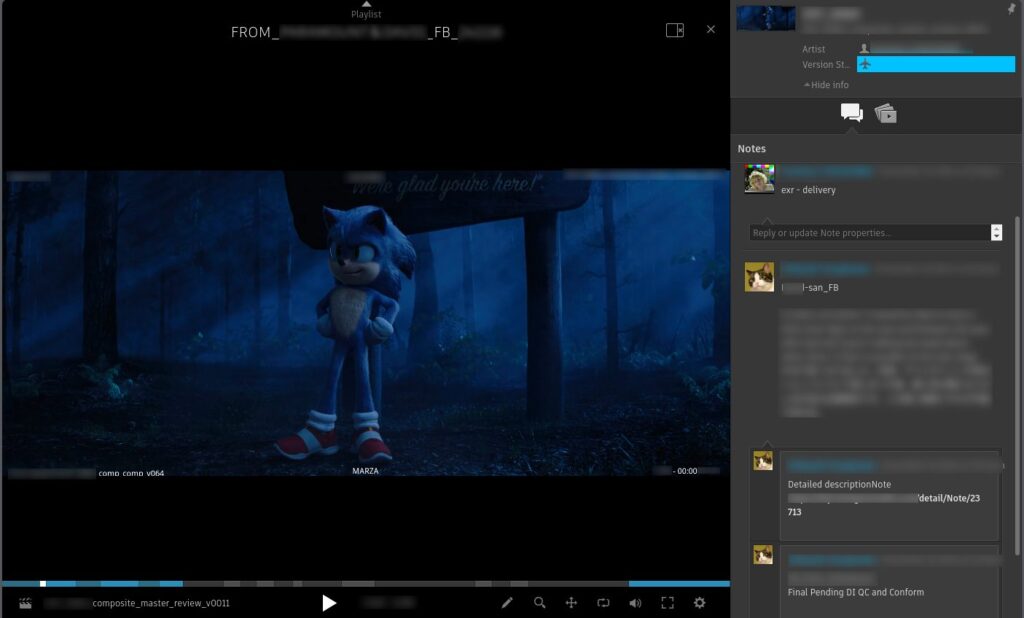
MARZA ANIMATION PLANET demonstrates how these workflows scale in production. During its work on Sonic the Hedgehog 3, the studio used Flow Production Tracking as the central hub for production communication, connecting artists in Japan with supervisors in Australia through shared playlists, version tracking, review notes, and status updates. By integrating Flow Production Tracking with its in-house pipeline, MARZA automated version publishing, preview generation, and review workflows, eliminating manual handoffs while keeping every decision tied to production context. Combined with a modern USD-based pipeline and Arnold rendering, these connected workflows helped MARZA manage complex global collaboration while maintaining production speed and consistency.
Identity, policy, and provenance that travel with assets
Connected workflows depend on more than fast collaboration—they depend on trust. As assets, reviews, and production data move between teams, vendors, and cloud services, identity, policy, and provenance must travel with them to preserve security, accountability, and creative intent.
- Identity ensures contributors see the correct version and understand its role in the pipeline
- Policy defines who can access, modify, or review assets based on role, scope, and contractual requirements.
- Provenance preserves version history, approvals, and frame-accurate notes as assets move through production.
Studios address these principles through secure zones and role-based permissions, rather than facility-based security. Review environments apply the same logic with folder-level controls, watermarking, multi-factor authentication, and restrictions on how high-resolution media is shared. Provenance moves with the asset, allowing contributors to inherit not just the latest file, but the decisions that shaped it.
As AI becomes more deeply integrated into production workflows, this connected record becomes even more important. Teams must distinguish between artist-authored work, AI-assisted material, and supervisor-approved revisions. Identity and policy determine where AI can operate, while audit trails preserve transparency around how every version was created, reviewed, and approved. Together, these controls enable distributed teams to move quickly without compromising authorship, accountability, or control.
Operational intelligence for managing remote production at scale
When production data stays connected across schedules, tasks, reviews, and creative workflows, studios gain more than visibility—they gain a real-time view of how production is progressing. Instead of relying on spreadsheets, slide decks, and status meetings to understand what’s happening across a production, teams can monitor progress continuously as work moves through the pipeline.
Connected dashboards, such as those in Flow Production Tracking, turn this data into actionable signals. Time-series graphs reveal changes in production pace. Status histories show where shots repeatedly cycle through review. Workload heatmaps expose bottlenecks, and burndown charts indicate whether current throughput meets upcoming targets. These views sharpen day-to-day decisions: how work is distributed, how much remains in each stage, and when to adjust plans. For distributed teams, a shared dashboard becomes the most reliable real-time picture of project health.
As more of the pipeline moves to the cloud, this intelligence can move beyond reporting to supporting action. Shifts in workload can trigger automated responses, such as scaling render capacity, routing submissions to available reviewers, or throttling noncritical processes during peak demand. Predictive signals can also identify sequences at risk of delay, giving teams the opportunity to make smaller course corrections before schedules or budgets are affected. Rather than reacting to production issues after they occur, studios can identify risks earlier, adapt more quickly, and keep projects moving with greater confidence.
Rethinking metrics: Decision velocity as the new KPI
Traditional production metrics—render time per frame, machine utilization, and shots delivered—measure how efficiently technology is performing. In a cloud-native, connected production pipeline, however, the more meaningful question is how quickly teams can review work, align on decisions, and move production forward.
Research from virtual production and LED volume studies shows that when creative decisions happen earlier, location costs can fall by 40–50% and post-production time can be reduced by roughly 30%, largely by avoiding late reshoots and downstream fixes.
This shift gives rise to new KPIs. Remote studios increasingly track time to creative decisions, notes-to-approval ratios, and the practical cost of change. Because cloud-based production management tools already record task movement, review cycles, and approvals, these metrics can surface directly in live dashboards. Flow Production Tracking can help teams see how many shots are in progress, how quickly decisions are being made, where change costs are spiking, and which departments are stuck in review churn. Ultimately, the goal isn’t simply to deliver more shots or maximize infrastructure utilization—it’s to shorten the time between creative intent and creative action.
How connected workflows drive momentum
Remote production isn’t simply about moving work to the cloud. It’s about ensuring footage, production data, reviews, and creative decisions remain connected as work moves between teams, tools, and locations.
When production context travels with the work, studios spend less time reconstructing information and more time creating. Editorial, animation, VFX, and production teams can respond to change more quickly, make informed decisions earlier, and maintain creative alignment throughout the production lifecycle. AI-powered scheduling, real-time review, and operational intelligence all build on this same foundation: connected workflows that keep every department working from a shared source of truth.
Flow Capture and Flow Production Tracking support these workflows by connecting review, production tracking, and collaboration across distributed teams. Together, they help studios reduce manual handoffs, preserve production context, and adapt more quickly as projects evolve. As productions become increasingly distributed, studios with connected workflows will be better equipped to adapt to change, keep teams aligned, and move projects forward with confidence.
Frequently asked questions (FAQs)
Remote production is a production model that enables creative teams to collaborate from different locations using cloud-based tools and connected workflows. Media, production data, reviews, and approvals are shared in real time so editorial, VFX, animation, and production teams can work simultaneously instead of waiting for files to be transferred. This approach helps studios scale talent globally, reduce delays, and maintain creative alignment throughout production.
A cloud production pipeline is a workflow that manages media, production data, reviews, and creative tasks using cloud-based infrastructure instead of relying solely on on-premises systems. It enables distributed teams to access shared assets, collaborate in real time, and keep production information synchronized throughout the production lifecycle. Cloud production pipelines improve scalability, flexibility, and visibility across every stage of production.
Remote production describes how people collaborate across different locations, while cloud production describes the technology and infrastructure that make that collaboration possible. A remote production uses cloud-based tools to share media, production data, and reviews, enabling teams to work together without being in the same facility. Together, remote production and cloud production help creative teams collaborate more efficiently across distributed workflows.
The biggest challenges of remote production include maintaining version control, protecting media security, coordinating reviews across distributed teams, and preserving production context as work moves between departments. Without connected workflows, teams can lose time searching for assets, tracking approvals, or reconciling conflicting feedback.
Flow Capture helps address these challenges by centralizing production data, reviews, permissions, and collaboration in a secure, cloud-based environment. Rather than relying on fragmented on-premises systems, teams benefit from centralized security controls, encryption, continuous monitoring, and detailed audit trails – making it easier to protect content while enabling seamless collaboration.
A cloud-native production workflow is designed to run primarily in the cloud rather than adapting traditional on-premises processes. Media, metadata, production tracking, reviews, and approvals remain connected in a shared environment, allowing teams to collaborate from anywhere while maintaining security and production context. This approach makes it easier for studios to scale resources, automate workflows, and respond quickly to production changes.
A camera-to-cloud workflow automatically uploads footage and metadata from set to cloud-based production systems as media is captured. This allows editorial, production, and VFX teams to begin reviewing, logging, and preparing work almost immediately instead of waiting for physical media transfers. By making content available earlier, camera-to-cloud workflows shorten production timelines and improve collaboration across locations. Flow Capture enables secure camera-to-cloud workflows with cloud-based dailies, review, and approvals.
Connected production workflows link media, production data, reviews, schedules, and approvals within a shared production environment. As work moves between departments, creative and technical context travels with every asset, reducing the need to reconstruct information from emails, spreadsheets, or disconnected tools. The result is a more efficient pipeline that helps teams stay aligned from capture through final delivery.
AI improves production scheduling by analyzing deadlines, dependencies, team capacity, and project priorities to generate optimized production plans. Rather than manually updating schedules as work changes, production teams can evaluate multiple scenarios and quickly adapt to shifting requirements. This helps reduce bottlenecks, improve resource allocation, and keep projects on track while preserving human oversight of creative decisions. Capabilities like Flow Generative Scheduling in Flow Production Tracking help studios evaluate scheduling scenarios using live production data.
Real-time review and approval allows filmmakers, producers, editors, and VFX artists to review media, leave frame-accurate feedback, and approve work as soon as new versions become available. Comments, annotations, and approvals remain connected to the associated assets, helping every stakeholder work from the same source of truth. This reduces review cycles and speeds creative decision-making across distributed teams. Flow Capture Rooms enables secure, collaborative review sessions with synchronized playback and frame-accurate annotations.