 Autodesk Media & Entertainment
Learn how character lead and film director Lou Hamou-Lhadj has refined character modeling and rigging, and how he approached updating the beloved Mr. Incredible for Incredibles 2.
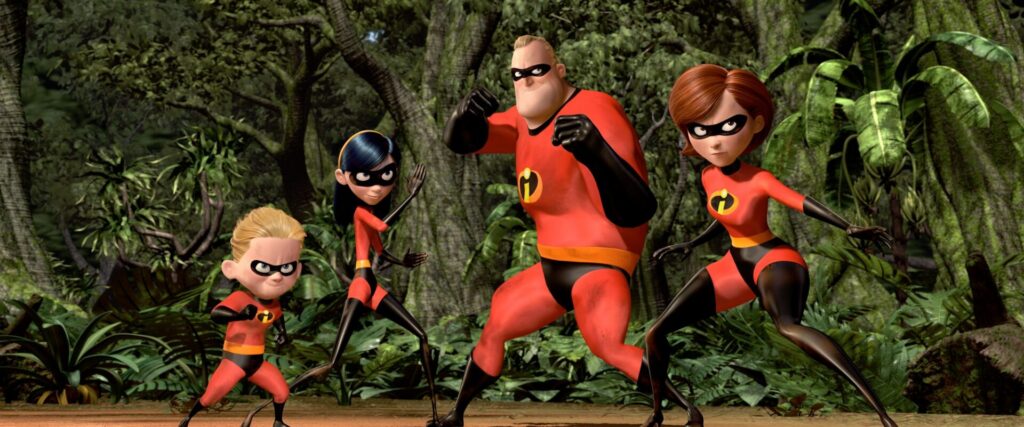
When Pixar released the original The Incredibles in 2004, it immediately set a new standard for animation style and technical prowess while bringing a fresh spin to the superhero genre. The film was both a commercial and critical success, grossing more than $600 million worldwide and winning an Academy Award for Best Animated Feature.
Unlike most superhero movies, Pixar chose to take a long break rather than rush into the next sequel. It wasn’t until 2018 that the creative team had the right pieces in place to release Incredibles 2, which picked up immediately after the first film and went on to gross more than $1.2 billion worldwide. A third film, currently in development, was announced at D23 in Anaheim in August 2024.
The Incredibles franchise was not only a massive cultural hit but also inspired an entire generation of filmmakers, animators, and creatives. Pixar’s Lou Hamou-Lhadj was among those in awe of what was then a cutting-edge animation style. Hamou-Lhadj’s nearly 20-year career at Pixar includes work in the characters department on many of the studio’s beloved franchises. In addition to his character work, he has directed several projects, notably the Academy Award-nominated short film Borrowed Time and on the Emmy-winning Disney+ series Win or Lose.
“I was a nerdy film student in New York,” Hamou-Lhadj said during a presentation at the 2026 Annecy Festival. “I distinctly remember when the Museum of Modern Art opened an exhibit celebrating Pixar’s 20th anniversary. It was a retrospective, chock full of amazing artwork from the studio archives, truly a testament to the fusion of art and technology that the studio holds at its core. And there was this one screen that, every 20 minutes or so, would loop a video. In that video, for a brief moment, you could see the wireframe turnarounds of some of the most iconic characters in modern animation. This was 2005, just after The Incredibles had released, and there was literally nothing on the internet about how this stuff was done at a professional level.”
That exhibit would prove pivotal for Hamou-Lhadj, as many years later, he would lead the character modeling and rigging work for Mr. Incredible himself on Incredibles 2.
Revisiting Mr. Incredible
For Hamou-Lhadj and the Pixar team, the process began as it always does: with the art. Revisiting a character as beloved as Mr. Incredible, especially one whose original design helped define the look of an iconic animated feature, required equal parts research, respect, and reinvention. As a longtime fan of the first film, Hamou-Lhadj said the goal was not to impose a new personal style on the character but to study the original intent behind him. That meant poring over the late Kent Melton’s maquettes and Tony Fucile’s original designs, then rebuilding Mr. Incredible from the ground up using today’s tools. The most visible updates appeared in his body, where anatomy, topology and style had to work together to preserve the character’s distinctive silhouette while advancing the film’s graphic, mid-century-modern design language.
That process also required a careful approach to topology.
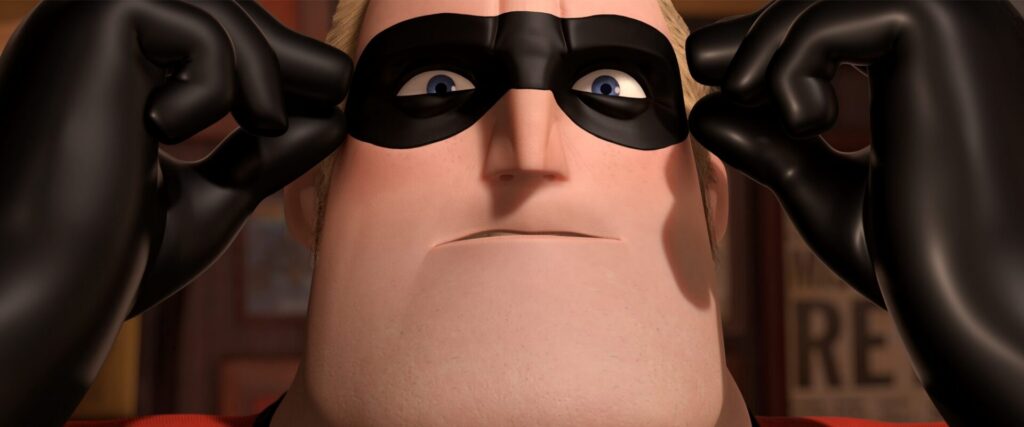
At Pixar, character technical directors handle both modeling and rigging, so efficiency must serve the artist’s needs and the character’s performance. One technique Hamou-Lhadj highlighted was the use of low-resolution warp meshes, an approach he first developed for broader use on human characters while making his independent short film Borrowed Time. The challenge was practical: with a small team and multiple characters, he needed a way to share weights and corrective shapes across characters with very different faces, bodies, and topologies. By placing that rigging information on a shared, low-resolution body mesh, the final rendered characters could remain topology-independent. In other words, the visible character models did not need to carry the rig themselves. The shared mesh carried the underlying rigging data and could be reshaped to drive different characters.
“And this idea isn’t new, by the way,” Hamou-Lhadj said. “A similar thing can be accomplished in Autodesk Maya using a wrap deformer. What is unique about Pixar’s version is the way that the rigging information flows. Our tools allow us to further refine per character on top of the inherited weights and correctives, and live update the low-res opinions at any time. There’s no one-time transfer or baking.”
Using Mr. Incredible as an example, Hamou-Lhadj demonstrated how this lower-resolution approach works in Maya. Mr. Incredible’s final character model is detailed but not overly complex. Even so, it still has too much geometry to make every movement easy to control across the whole body. To address this, the Pixar team works with a simpler version of the character underneath. This version preserves Mr. Incredible’s major shapes, body mass, and strong design lines while removing unnecessary detail. That makes the character easier to pose, shape, and refine while still preserving his iconic look.

The Pixar team retains extra detail in two key areas: the face and the hands. These are the parts of a character that audiences see most often in close-up, so they need to move with the greatest precision and expression. As the model moves away from those areas, the team reduces detail in smart places, such as around the elbow or under Mr. Incredible’s chin. Those spots already have natural creases or sharp changes in shape, which help hide small imperfections during animation. By the time the final image is rendered, those issues are smoothed out and disappear.
“The truth is we don’t just magically come to this low-resolution mesh and then have it ‘up-res,’” Hamou-Lhadj said. “I actually work backward from finding the final form of Bob, and then strategically removing the spans that I don’t need in order to support his deformation. But where I start contains all the information that I need to set up a successful character, with all of the edge loops contained in very specific configurations that are easily transformed and then specified later. It contains no preconceived notions of what the film language is for any particular project, so I will pull this from project to project and start with it as a base.”
Anatomical landmarks
To decide where that simpler mesh should hold detail, Hamou-Lhadj first looks to anatomy. For character artists, he said, it is essential to understand how bodies work, whether human or animal. That means looking beyond the surface shape and studying the muscles and structures beneath. One method he highlights is écorché sculpture, a traditional anatomy exercise in which artists build the body muscle by muscle, often in clay. Years ago, Pixar hosted a workshop with Andrew Cawrse of Anatomy Tools that used this approach, giving artists a hands-on way to understand how each muscle group works.
That kind of anatomical knowledge gives artists a clearer guide when building a character model. Instead of placing lines and shapes simply because they seem to fit, they can make more deliberate choices based on how the body is built and how it needs to move. Hamou-Lhadj describes this as a kind of map for the model. By thinking of the body in smaller, functional sections, the team can place detail where it supports the character’s movement, shape and performance.
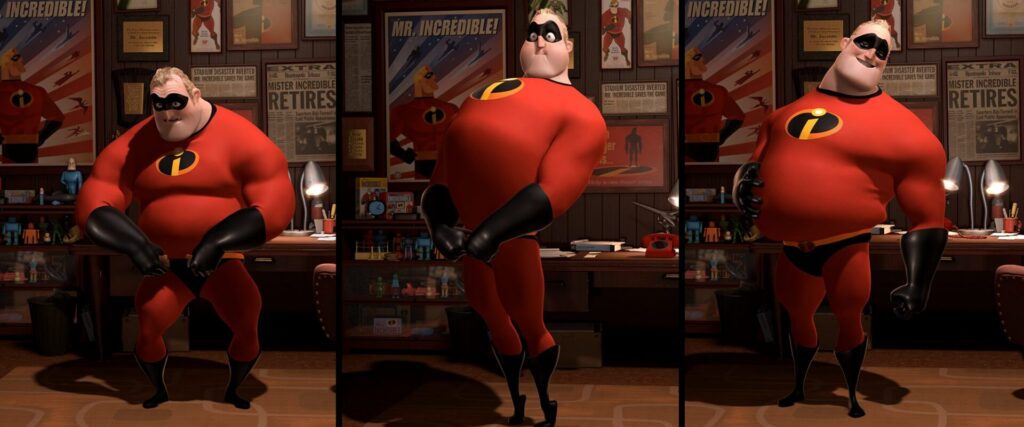
“I use color sets in Maya to do this very thing,” Hamou-Lhadj said. “With Bob, I was super intentional with the edge flow to place landmarks in key areas. I have to stress that in today’s production reality of high-poly sculpting and tiny budgets, topology is often thought of as a means to an end. Sort of a technical inconvenience to be done with as quickly as possible. My opinion is that it very much is not, and yes, you can throw tons of spans onto a sculpt or a scan, and it’ll hug the shape well enough, but it will move terribly. You will invisibly spend more time and money in rigging and animation fixes than you would have had you taken the time to set yourself up for success.”
Updating a classic with today’s technology
For Hamou-Lhadj, the biggest challenge was not simply re-creating the Mr. Incredible audiences saw in 2004. It was finding the version of the character audiences remembered. Looking back at the original film, the work remains remarkable, but the era’s technical limits are easier to see today. The goal, then, was to separate the essence of Bob Parr from the era’s technical artifacts. Rather than preserve every detail exactly as it appeared on screen, the team returned to the original designs and sculpts to better understand the character’s intent, then used modern tools to bring that idealized version forward.
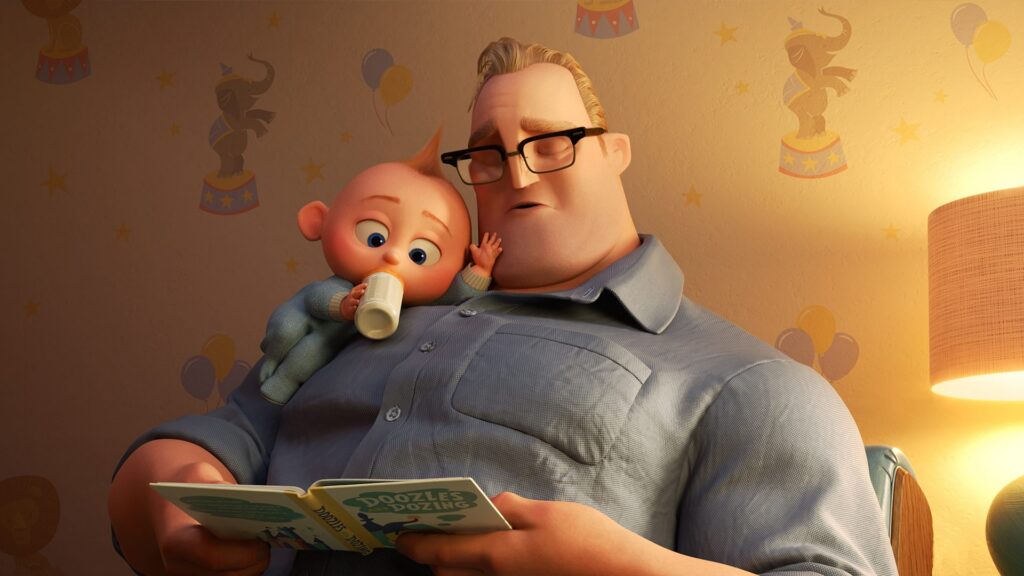
That balance was especially delicate in Bob’s face, where even small changes could affect whether audiences immediately recognized him as Mr. Incredible. Hamou-Lhadj said he initially worked hard to preserve subtle details from the first film, including a bit of asymmetry in Bob’s brows that he had always found charming. But in conversations with Tony Fucile, who designed the character for the original film, he came to see that not every familiar detail needed to remain.
“Having those conversations with the original filmmakers, making sure we’re honoring what they were trying to do back then and what they want to do now, was really the partnership that allowed us to say, OK, we can walk away from some of that,” Hamou-Lhadj said. “We don’t need to be wholly honorific in that sense.”