 Autodesk Media & Entertainment
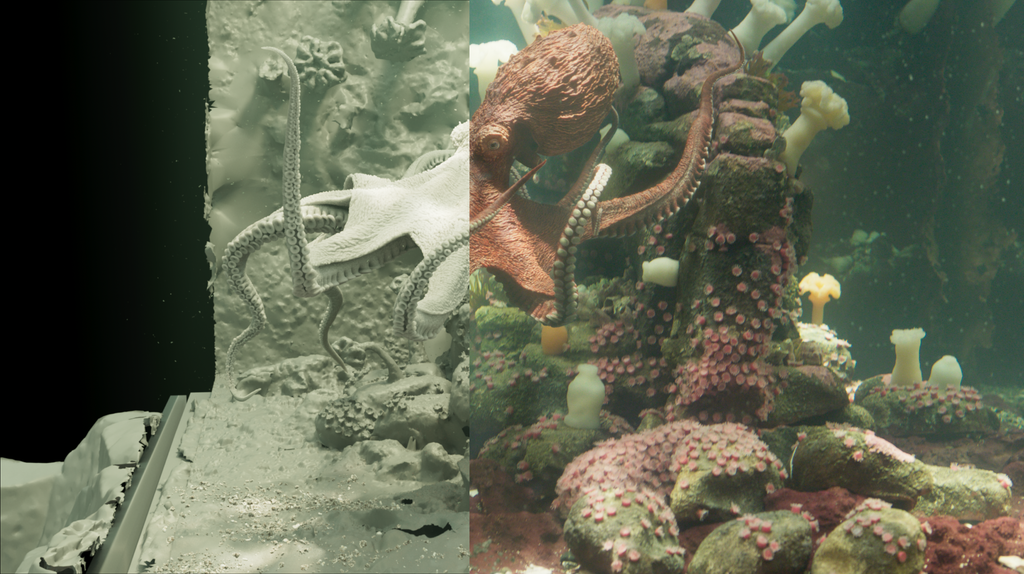
Based on the novel by Shelby Van Pelt, Netflix’s Remarkably Bright Creatures—which won the Emmy for Outstanding Movie—follows the bond between a widow, a young man, and a clever octopus. The film’s director, Olivia Newman, and VFX supervisor, Chris Ritvo, made the call early on: the octopus would be entirely CG. It’s a tall order: octopuses have such striking, expressive skin, capable of shifting colors and textures in an instant, that getting them to feel real meant nailing every little detail. That challenge fell to the talented team at Untold Studios, who turned to Autodesk Arnold for lighting and rendering. Lighting Supervisor Alexandre Scott shares what it took to make Marcellus believable on screen and a character audiences could (and did) fall in love with.
Alex, what’s the responsibility of a lighting supervisor?
A lighting supervisor guides the team’s artistic and technical execution. The main difference from a lead is that a supervisor actively directs the team and provides creative notes to ensure consistency. Day-to-day, this involves bidding the work with Production, running dailies with other Supervisors, planning and methodology, assigning shots, creating and managing templates, tackling bugs and showstoppers, dealing with bottlenecks, and collaborating with other departments to ensure seamless handoffs.

The film touches on the theme of home. Where and when do you do your best work, Alex?
I enjoy the quiet focus of working from home, but I honestly love being in the office with my team. The hybrid flexibility at Untold Studios gives me the best of both worlds.
What’s the biggest challenge of working on an octopus, of all creatures?
Underwater lighting is inherently tough to make believable. Beyond basic plate integration, nailing the beauty lighting was challenging because Marcellus is often perfectly still—there’s no fast action to hide behind. The breach shots, where Marcellus is half in and half out of water, were especially difficult. We had amazing, high-resolution, detailed water sims which looked phenomenal, and some of the underwater tank shots were quite difficult when trying to match the caustic patterns. Honestly, Anim and CFX had very difficult jobs. In addition to that, we had an incredible asset and lookdev to work with. This made lighting so much easier.
What kind of preparation did you do before working on a creature that needs to feel so real? Did you visit Agnetha?
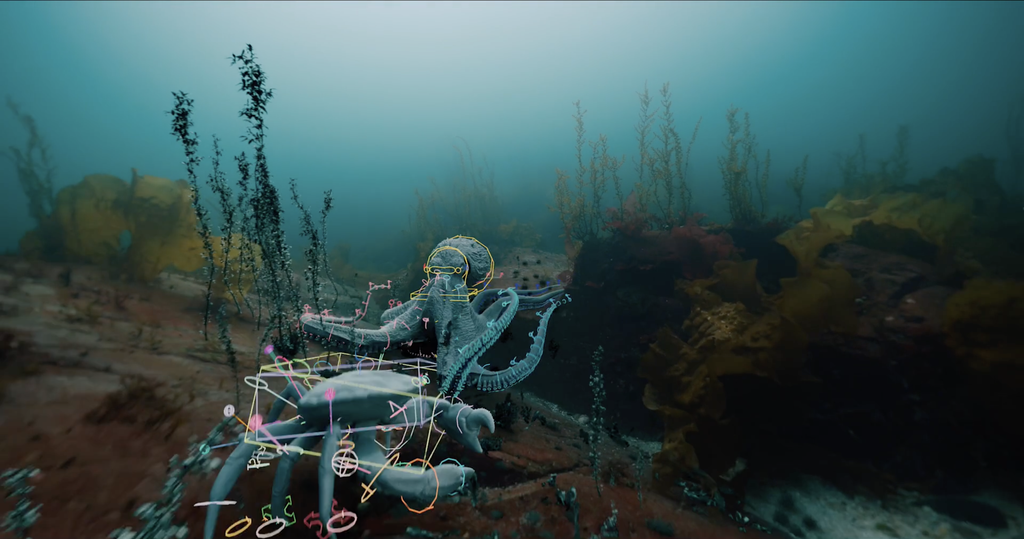
We relied heavily on reference. Our VFX supervisor, Chris Ritvo, shot a ton of it. Since Marcellus is based on Agnetha from the Vancouver Aquarium, we had plenty of specific footage of her. Sadly, I wasn’t able to visit Agnetha in person in Vancouver. However, we do have an octopus at the Toronto Zoo locally, and I went there to take some snaps for myself. We also studied John Roney’s underwater photography. Personally, I keep a mood and reference board up while I’m working to ensure the lighting stays grounded in reality but also supports the appropriate emotional tone of the shot.
Why did you choose Autodesk Arnold for this project?
Arnold is a phenomenal renderer that handles massive datasets flawlessly. Its out-of-the-box shaders provide reliable physical accuracy without constant tweaking, which is why we rely on it for all of our hero creature work at Untold Studios. In general, I feel that Arnold is a great blend of user friendliness and flexibility.
How complex was Marcellus’ render mesh? What about his shading network?
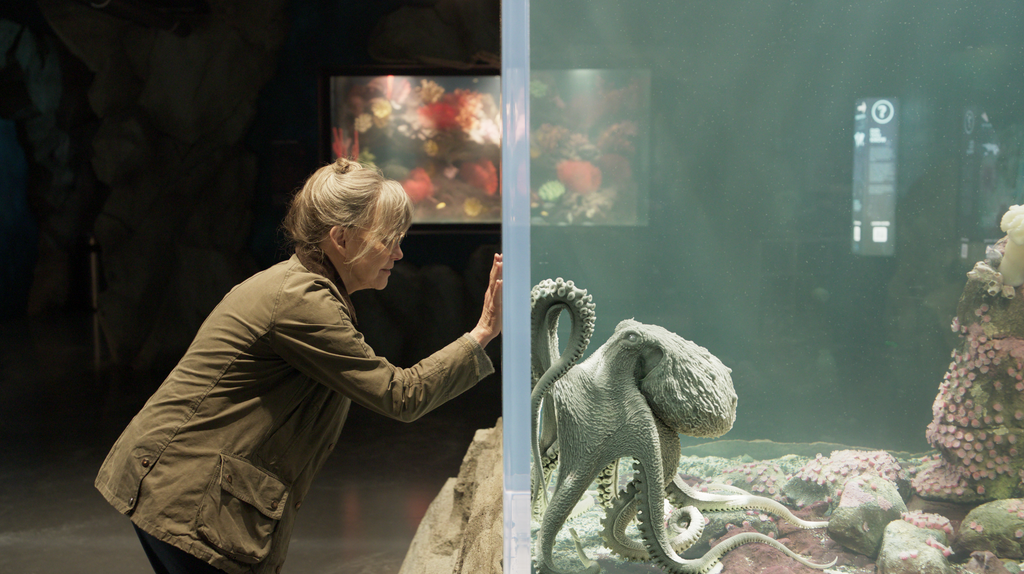
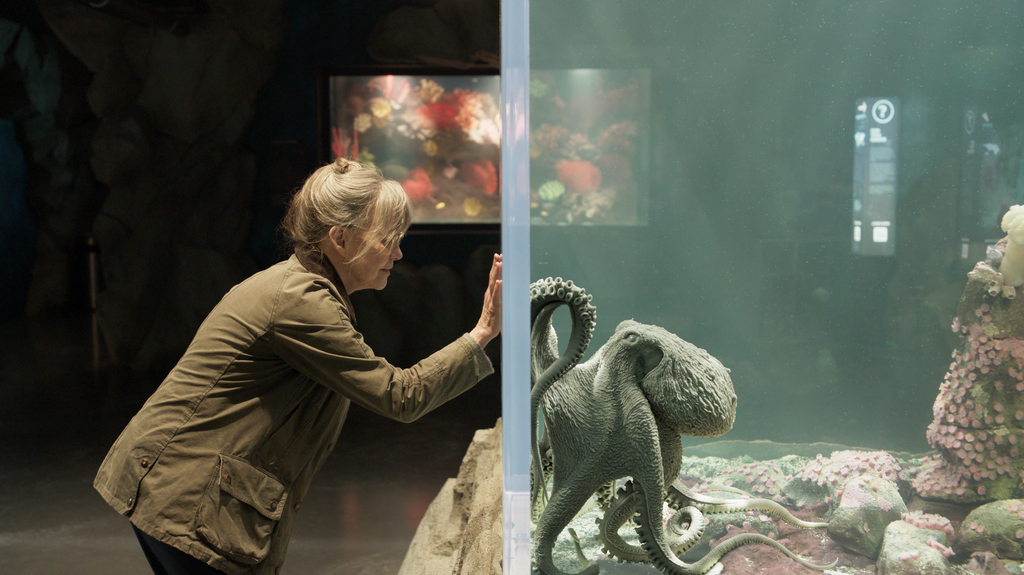
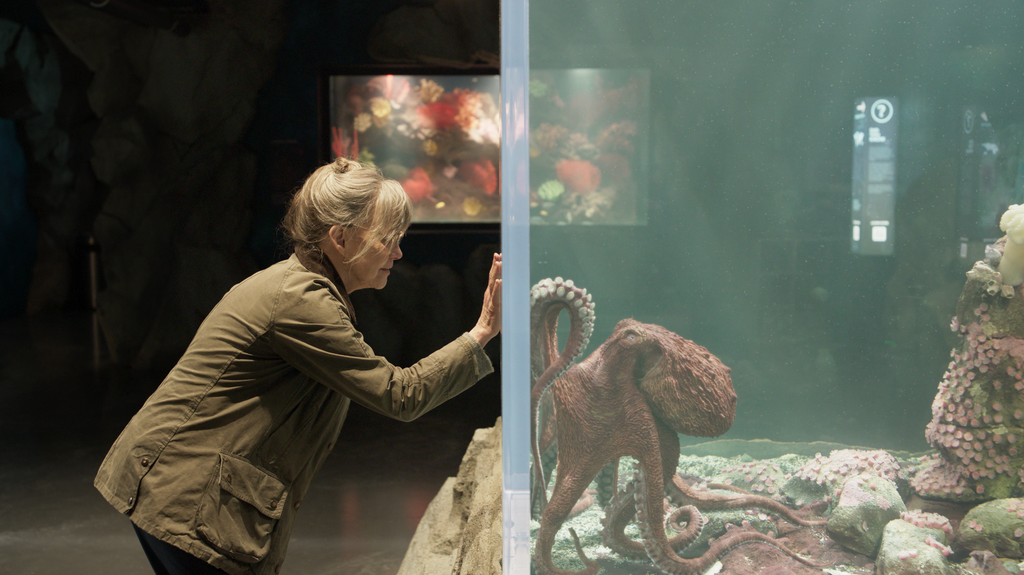
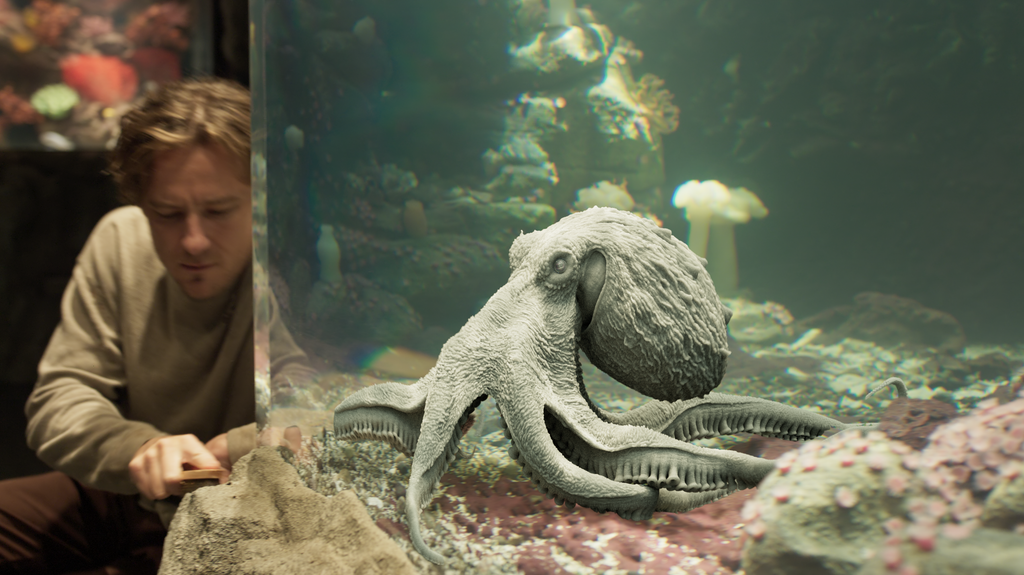
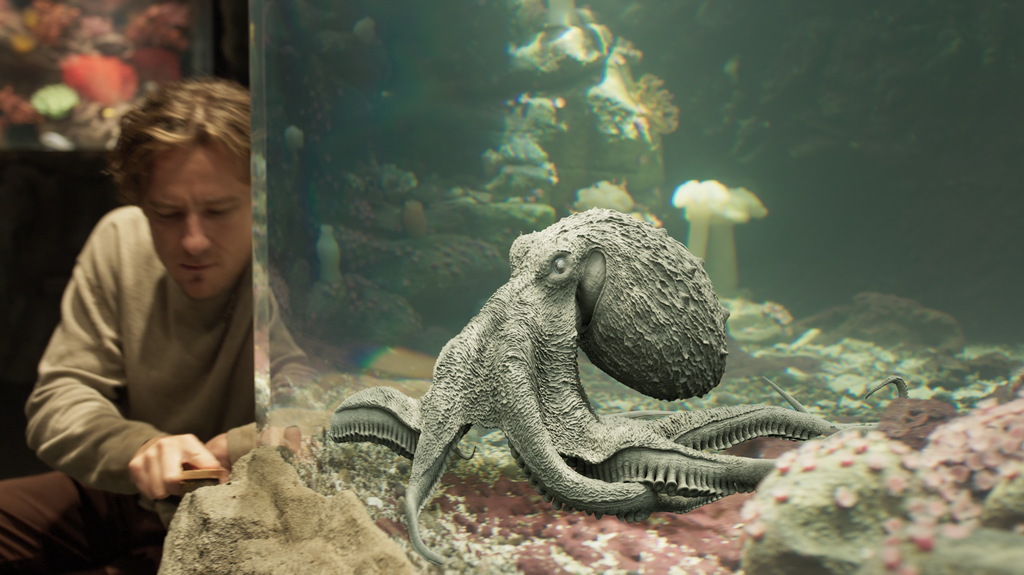
Marcellus’ displaced mesh was incredibly dense. After three or four subdivisions, it used over 128GB of RAM, so we relied heavily on adaptive subdivision. The shading network was also complex. True to “look development,” it never really stopped; we tweaked it right up to the final round renders. We managed several look variations for underwater, out of water, and camouflage states, and provided numerous utility AOVs for Comp.
Marcellus changes colors multiple times throughout the film to camouflage and even appears a bit whiter as he ages. How did you approach that?
As I mentioned, we had several lookdev variations for Marcellus. We also built in controls for his age and sickness levels, which progressed throughout the film. We managed these adjustments on a per-sequence basis.
Marcellus being in a water tank adds a whole new level of VFX fun. How did you make it believable?
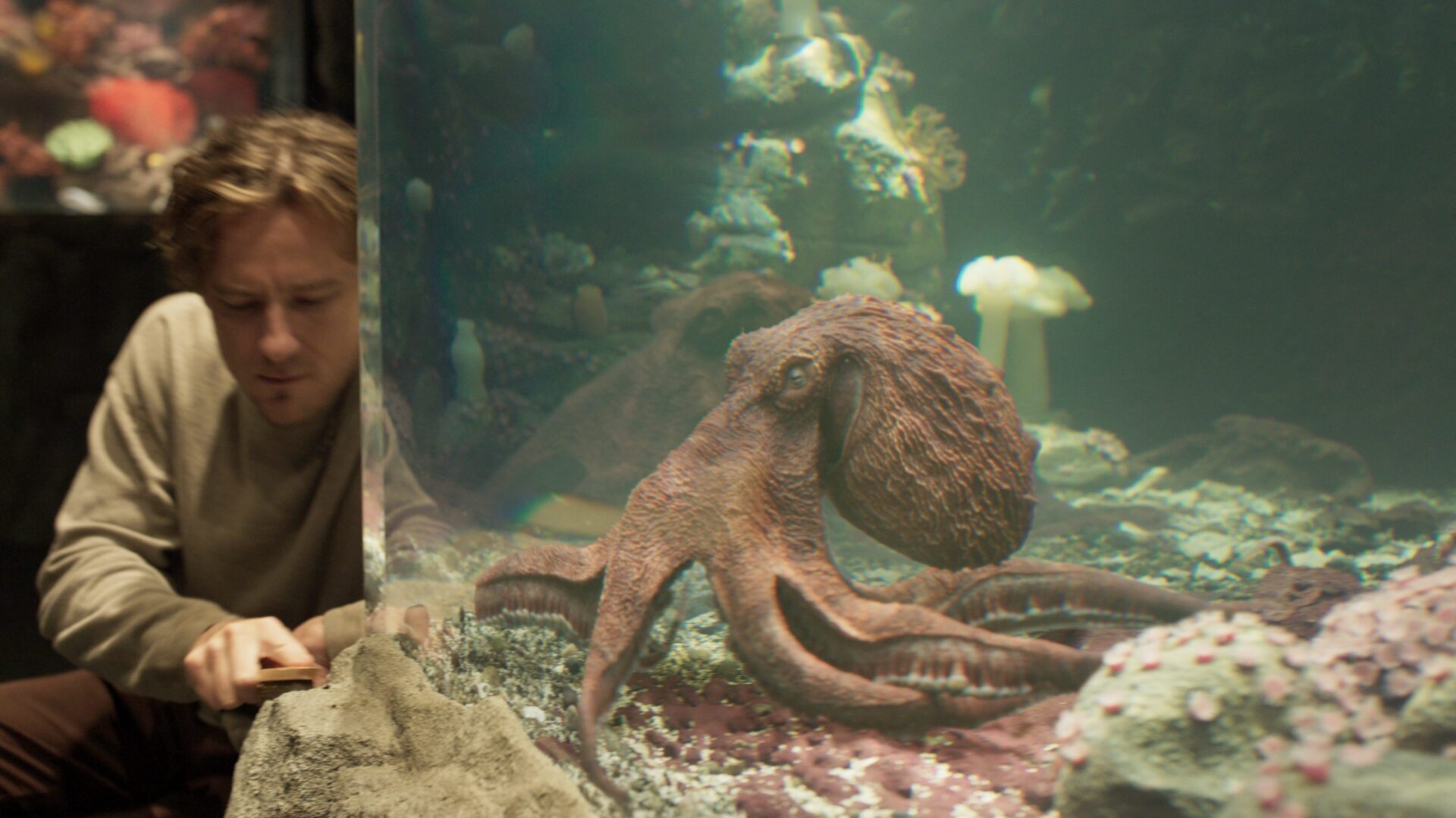
The underwater tank shots were particularly challenging. Beyond dialing in the underwater shading, we added elements like floating detritus, caustic rays, and pebble kick-up for believability. We also had to refract Marcellus accurately through the aquarium glass. During camera pans, the refraction distortion is dramatic, and depending on the angle, you can often see multiple reflections and refractions of him at once. Thankfully, Arnold has a great transmit AOV setup, so we were able to properly refract all the layers and AOVs for Comp accurately right out of the box.
What often keeps you up at night as a lighting supervisor?
The farm. Always the farm. Untold Studios is entirely in the cloud, which is fantastic because we can scale our render capacity based on project or delivery needs. But you never know when an unforeseen issue will crash things, and there is nothing worse than waking up to a wall of red errors.
What are some features in Arnold you continuously rely on that take some of the pressure off?
I hadn’t used Arnold much before coming to Untold, but I’ve really been enjoying the ROP context operators. Being able to procedurally override anything at render time is incredibly powerful, and it’s a great bridge to a Solaris style workflow.
Beyond getting the look technically right, how much do you think about what each look needs to convey emotionally?
Matching the lighting to the emotional tone of the shot is half the battle. Often, we have to adjust distracting elements to make a shot work—like a caustic pattern moving too fast or lighting that’s not soft enough. Sometimes there are elements that are not present in the plate that need to be added, like maybe Marcellus needs to be a little bit silhouetted against the plate because he’s blending in a little too well. Or maybe we need to increase the key to show off the beautiful performance that animation and CFX have done or hit him with a subtle rim to make him pop with color for some of the more upbeat shots. Once the lighting is set up for plate integration, you really have to massage it into place to make it look good and feel emotionally right for the shot.
What new ways to work with Arnold are you exploring? Have you adopted USD yet?
Yes, we’ve completed several projects using USD and Solaris at Untold. Adam Chebane and several other talented people are currently developing our USD/Solaris pipeline. USD/Solaris allows for non-destructive, collaborative workflows across departments, vendors, and significantly speeds things up from an organizational standpoint. Simply having your sequence recipe in one graph makes all the difference. With vanilla Houdini you have your template scattered across several networks and there is a lot of jumping around. Additionally, there are many things that are much easier to do with USD/Solaris – nested instances for large environments for example.
What was your review process for the film? Walk me through it.
We use RV in Autodesk Flow Production Tracking and Hiero for full blown EXR dailies. I quickly review renders and auto-comp dailies straight off the farm. I frequently use Flow Production Tracking’s ‘Play in Review’ to compare upstream dailies and ensure we have the latest versions. In a pinch, we’ll use it for dailies as well.
Our review process was fairly typical for a feature, with dailies once or twice a day alongside the lighting team and VFX Supervisor. The focus shifted depending on the stage of production. Early on, we set up sequence light rigs, matched reference materials, and did initial creative passes to render style frames for key shots. In the middle of production, we dove into beauty lighting and ran sequence dailies to ensure everything worked in context. Towards the end, we shifted to technical and optimization dailies—especially since we were rendering at 4K—to ensure sampling quality was perfect for Comp as we crossed the finish line.
Do you use the Autodesk Media & Entertainment Collection [includes x5 Arnold]? If yes, how does it make your job easier?
I can’t speak for other departments, but MotionBuilder, Mudbox, Maya, and other Autodesk tools are used with great success throughout our pipeline. Arnold is an incredibly capable renderer; I’m not sure we could have nailed the underwater and tank shots without it.
This film had Vancouver locations and Ontario VFX work behind it. A real coast to coast Canadian effort. What is it about the talent or culture here that makes Canada such a strong home for this kind of work?
Canada has always had a strong VFX pedigree. Vancouver, Toronto and Montreal all have thriving film industries and diverse locations. We’ve always had amazing talent spread across the country. That being said, Untold is a global company, and we had incredible artists working on this from London and our other sites as well.
Is there a shot or sequence you’re especially proud of?
Some projects just come together perfectly. From the supervisors and production down to the artists, we had an amazing team at Untold, and it really shows in the work. I’m incredibly proud of our work as a whole. If I had to be specific—spoiler alert—it would be the final sequence where Marcellus returns to the water to go home to his final resting place. The hero water sims for these shots are simply incredible. I also love the aquarium shots of him resting on the rocks, bathed in light with caustics dancing over him. These shots turned out so well that I found myself enjoying the visuals and forgetting to scrutinize them on a technical or creative level. That to me is the mark of great VFX.
Watch Remarkably Bright Creatures on Netflix.